Apple Unleashes the M5 Era and Shocks Everyone With the $599 MacBook Neo
- Turker Senturk
- Hardware , Technology
- 09 Mar, 2026
- 14 min read
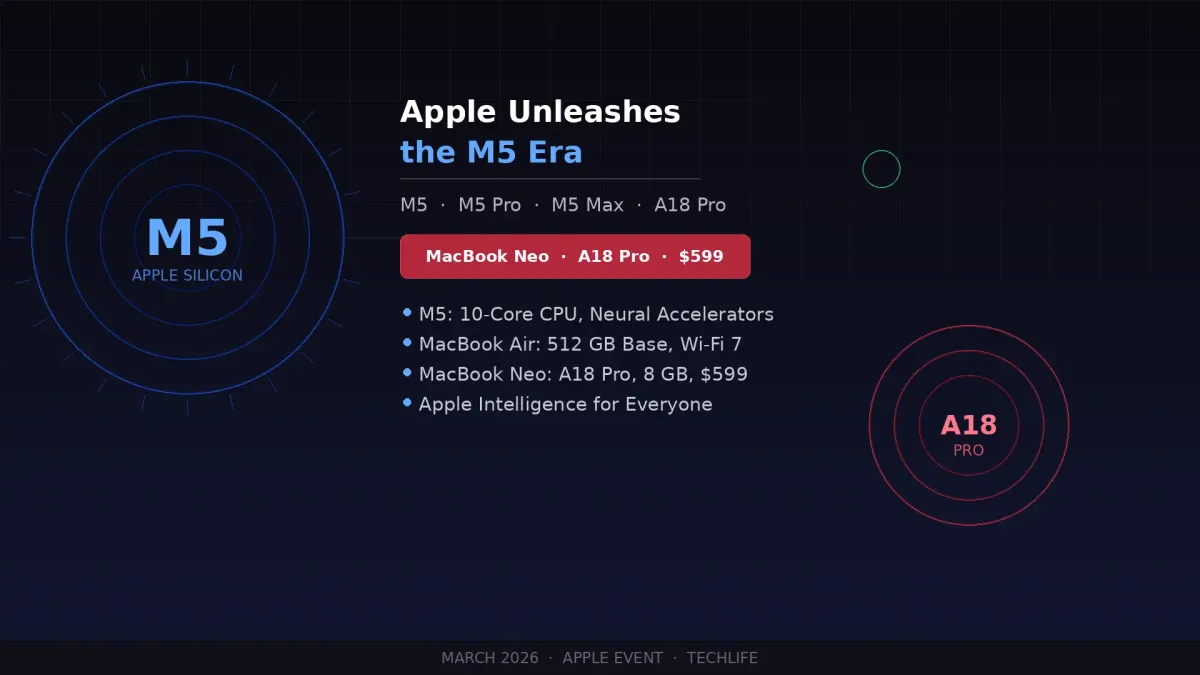
Apple just threw down the gauntlet. At its highly anticipated March 2026 event — held simultaneously in New York, London, and Shanghai — the company didn’t just iterate. It redefined what we should expect from a product launch. The star-studded lineup included the M5-powered MacBook Air, new M5 Pro and M5 Max MacBook Pros, and the real shocker: an entirely new product category called the MacBook Neo, a $599 AI-capable laptop powered by an iPhone chip that could fundamentally change who buys a Mac and why.
Let’s break down everything Apple announced and what it means for the rest of the industry.
The Silicon Leap: M5 Comes to MacBook Air and Pro
If Apple Silicon was a revolution, the M5 is the moment that revolution hits its stride — and gets really fast.
Apple’s latest chip generation, built on third-generation 3-nanometer process technology, delivers improvements that go well beyond incremental upgrades. The M5 was first introduced in the MacBook Pro and iPad Pro in late 2025, and now it makes its way to the MacBook Air lineup. Meanwhile, the MacBook Pro gets upgraded with the M5 Pro and M5 Max variants.
The M5 Chip (MacBook Air)
The M5 chip powering the new MacBook Air is a meaningful step forward:
- CPU: 10-core, with what Apple calls the world’s fastest CPU cores
- GPU: Up to 10-core with Neural Accelerators in each core
- Unified Memory Bandwidth: 153 GB/s — roughly a 28% improvement over the M4
- Unified Memory: 16 GB base, configurable up to 32 GB
Apple claims the M5 delivers approximately 15% faster multithreaded CPU performance compared to the M4 and 30% faster GPU performance. But the real headline is the Neural Accelerator embedded in each GPU core, enabling up to 4x faster performance for AI tasks compared to the M4 MacBook Air. Whether you’re running local language models, applying advanced photo effects, or leveraging Apple Intelligence features, the M5 is purpose-built for the on-device AI era.
The GPU also benefits from enhanced shader cores and a third-generation ray-tracing engine, delivering roughly 50% improved gaming performance and significantly better real-time rendering quality.
M5 Pro and M5 Max (MacBook Pro)
The MacBook Pro gets its own silicon upgrade with the M5 Pro and M5 Max. While Apple hasn’t detailed every specification publicly in the same granular fashion, the M5 Pro and M5 Max bring the same architectural innovations — Neural Accelerators per GPU core, improved memory bandwidth, and enhanced power management — scaled up for professional workloads.
The M5 Pro and M5 Max MacBook Pro models also feature Apple’s new N1 wireless chip, delivering Wi-Fi 7 and Bluetooth 6 connectivity for faster data transfers and lower latency wireless connections.
What Makes the M5 Architecture Special?
Beyond raw numbers, the M5 family introduces a few key architectural innovations:
- Neural Accelerators in Every GPU Core: This is the big one. Rather than relying solely on the Neural Engine for AI tasks, the M5 distributes AI processing across the GPU itself. This means AI workloads can leverage both the Neural Engine and the GPU simultaneously, dramatically improving performance for tasks like image generation, language model inference, and advanced computational photography.
- Third-Generation Ray Tracing: The GPU includes a third-generation ray-tracing engine, improving real-time rendering quality in games and professional 3D applications.
- Faster Unified Memory: At 153 GB/s bandwidth in the base M5, the chip provides a meaningful boost for memory-intensive tasks. This is especially important for running AI models on-device, where model weights need to be loaded and accessed quickly.
- Enhanced Shader Cores: Better graphics performance for everything from gaming to professional video and motion graphics work.
The M5 generation isn’t just faster — it’s architecturally smarter, designed for a world where AI tasks are no longer optional but expected.
Pro & Air Refined: The Updated MacBook Lineup
With new silicon comes new hardware, and Apple delivered exactly what was expected — along with some welcome surprises.
MacBook Air (M5)
The MacBook Air continues to be Apple’s volume champion — the laptop most people actually buy. With the M5 inside and a significant storage upgrade, it gets a meaningful boost without sacrificing what makes it great:
- Chip: Apple M5 (10-core CPU, up to 10-core GPU)
- Display: 13.6-inch and 15.3-inch Liquid Retina displays with P3 wide color gamut and True Tone
- Storage: 512 GB SSD base (doubled from previous generation), configurable up to 4 TB, with 2x faster read/write speeds
- Memory: 16 GB unified memory base (configurable to 24 GB or 32 GB)
- Camera: 12MP Center Stage camera
- Battery Life: Up to 18 hours of video playback
- Connectivity: 2x Thunderbolt 4 (USB-C), MagSafe 3 charging, 3.5mm headphone jack
- Wireless: Wi-Fi 7 and Bluetooth 6 via Apple’s N1 wireless chip
- Colors: Sky Blue, Midnight, Starlight, Silver
- Starting Price: $1,099 (13-inch) / $1,299 (15-inch)
The doubled base storage from 256 GB to 512 GB is a particularly welcome change — the previous generation’s 256 GB base felt stingy for a laptop at this price point. Combined with 2x faster SSD speeds, the Air with M5 is a genuinely excellent all-rounder. It can now handle Apple Intelligence features with ease thanks to the boosted Neural Engine and GPU Neural Accelerators, making it a seriously smart daily driver rather than just a lightweight laptop.
One small note: the starting price has increased by $100 compared to the M4 MacBook Air. Apple clearly believes the storage and chip upgrades justify the bump, and honestly, they probably do.
MacBook Pro (M5 Pro & M5 Max)
The 2026 MacBook Pro brings the M5 Pro and M5 Max chips to Apple’s professional laptop line, along with meaningful upgrades:
- Chips: M5 Pro and M5 Max
- Display: 14-inch and 16-inch Liquid Retina XDR displays
- Storage: Faster SSDs with improved read/write performance
- Connectivity: Wi-Fi 7 and Bluetooth 6 via N1 wireless chip
- Starting Price: $2,199 (14-inch, M5 Pro) / $2,699 (16-inch)
For professionals, the MacBook Pro remains the gold standard. The M5 Pro and M5 Max bring the same Neural Accelerator technology and architectural improvements seen in the base M5, scaled up with more cores, more memory bandwidth, and more GPU horsepower for demanding workflows like video editing, 3D rendering, and AI model development.
The Showstopper: MacBook Neo at $599
And then came the “one more thing.”
The MacBook Neo is Apple’s boldest play in years — a completely new product line that brings the Mac to a price point Apple has never touched before. But what makes it truly fascinating isn’t just the price. It’s how Apple got there. The MacBook Neo is the first Mac to be powered by an A-series chip — the same family of processors that runs the iPhone. Specifically, it uses the A18 Pro, the chip that debuted in the iPhone 16 Pro in 2024.
This is a historic moment for the Mac lineup. Since Apple began its transition to Apple Silicon in 2020, every Mac has used M-series chips. The MacBook Neo breaks that tradition by repurposing a proven, highly efficient mobile chip for a laptop form factor — and the results are surprisingly compelling.
MacBook Neo Specs
- Chip: Apple A18 Pro
- CPU: 6-core (2 performance + 4 efficiency)
- GPU: 5-core
- Neural Engine: 16-core
- Display: 13-inch Liquid Retina, 2408-by-1506 resolution, 500 nits brightness, 1 billion colors, no notch (iPad-style uniform bezels)
- RAM: 8 GB unified memory (not configurable)
- Storage: 256 GB SSD (configurable to 512 GB)
- Battery Life: Up to 16 hours
- Weight: 2.7 pounds
- Ports: 2x USB-C (one USB 3 with DisplayPort 1.4, one USB 2) + 3.5mm headphone jack
- Wireless: Wi-Fi 6E, Bluetooth 6
- Camera: 1080p FaceTime HD camera
- Audio: Dual side-firing speakers with Spatial Audio and Dolby Atmos, dual-mic array with beamforming
- Touch ID: Available on 512 GB model only; 256 GB model features a Lock Key instead
- Design: Durable recycled aluminum enclosure (60% recycled content by weight)
- Colors: Silver, Blush, Citrus, Indigo (with color-coordinated keyboards)
- Charging: USB-C (no MagSafe)
- Starting Price: $599 ($499 for education)
Where Apple Cut Corners — and Where It Didn’t
Let’s be honest about what $599 gets you and what it doesn’t.
The MacBook Neo makes clear compromises to hit its price. The 8 GB of RAM with no upgrade path is the most obvious limitation — in 2026, that’s tight for heavy multitasking. There’s no MagSafe charging, no Thunderbolt, and the USB-C ports are a step down from the Air (one USB 3 and one USB 2, versus two Thunderbolt 4 on the Air). The 256 GB base model doesn’t even include Touch ID, opting for a simple Lock Key instead. The display, while bright and colorful, uses iPad-style uniform bezels rather than the thinner-bezel design on the Air, and the sRGB color space is narrower than the Air’s DCI-P3 coverage.
But here’s the thing: the fundamentals are real. The A18 Pro is a genuinely fast chip. Apple claims the Neo is up to 50% faster for everyday tasks like web browsing compared to the bestselling PC with the latest Intel Core Ultra 5, and up to 3x faster for on-device AI workloads. Early benchmarks show single-core performance that’s essentially identical to the iPhone 16 Pro, with a single-core score of 3461 and a multi-core score of 8668. The 16-core Neural Engine means Apple Intelligence runs natively and smoothly. The 1080p camera is solid. And the battery life — up to 16 hours — is outstanding for a $599 laptop.
The build quality also punches above its weight. The recycled aluminum enclosure feels like an Apple product, not a budget compromise. The four color options (Silver, Blush, Citrus, and Indigo) with matching keyboards give it a personality that no Chromebook can match. It’s easily the most colorful MacBook lineup Apple has ever offered.
Why the MacBook Neo Matters
This isn’t just another laptop. It’s a strategic product that serves multiple purposes for Apple:
Democratizing Apple Intelligence
Apple Intelligence — the company’s suite of on-device AI features including advanced Siri, Writing Tools, image generation with Clean Up and Genmoji, and context-aware notifications — requires Apple Silicon to run. Until now, the cheapest way to access these features on a Mac was the $1,099 MacBook Air. At $599, the Neo cuts that barrier nearly in half. At $499 for education buyers, it’s cheaper than most mid-range Chromebooks.
Competing With Chromebooks and Budget Windows Laptops
Apple has historically ceded the sub-$1,000 laptop market to competitors. Chromebooks dominate education, and budget Windows laptops own the entry-level consumer space. The MacBook Neo changes that dynamic. A $599 Mac with Apple Silicon, macOS, and the full Apple Intelligence suite is a fundamentally different proposition than a $600 Chromebook or a bargain-bin Windows machine. Apple is explicitly targeting Windows switchers — the product page even links to Apple’s “Mac Does That” comparison tool designed for hesitant PC users.
Expanding the Ecosystem
Every MacBook Neo sold is another user in Apple’s ecosystem — using iCloud, potentially subscribing to Apple One, buying apps from the Mac App Store, and eventually upgrading to an Air or Pro down the line. The Neo isn’t just a product; it’s an acquisition strategy. And at a time when Mac revenue fell nearly 7% in the holiday quarter before this launch, expanding the addressable market makes strategic sense.
The iPhone Chip Connection
There’s something clever about using the A18 Pro here. By repurposing a chip that’s already been manufactured in massive volume for the iPhone 16 Pro, Apple can dramatically reduce component costs compared to using an M-series chip. This is what makes the $599 price possible. It also means the MacBook Neo benefits from the A18 Pro’s incredible power efficiency, which is why it can deliver 16 hours of battery life from what is likely a relatively small battery.
Who Is the MacBook Neo For?
The Neo targets a few key demographics:
- Students: Reliable, lightweight, with all-day battery and full access to Apple Intelligence-powered study tools like note summarization and Writing Tools. At $599 (or $499 with education pricing), it’s competitive with mid-range Chromebooks and significantly more capable.
- Casual Users: People who browse the web, stream content, manage emails, and do light productivity work. The Neo handles all of this effortlessly, and the A18 Pro is more than enough for these tasks.
- First-Time Mac Users and Windows Switchers: The Neo is designed to convert Windows and Chrome OS users who’ve been priced out of the Apple ecosystem. Apple’s explicit marketing around “Mac Does That” and the familiar iPhone + Mac integration features make the switch less intimidating.
- Developing Markets: A more affordable Mac means Apple can expand into markets where $1,099+ laptops simply aren’t viable for most consumers.
It’s worth noting that the Neo is not meant to replace the Air. The Air remains the clear choice for users who need more RAM (16 GB+), faster ports (Thunderbolt 4), larger display options, wider color gamut, and more storage. The Neo is a new floor for the Mac lineup — not a replacement for the existing foundation.
Apple’s 2026 Strategy: The Big Picture
Zoom out, and a clear strategy emerges from this event.
Apple is betting heavily on two pillars: AI everywhere and accessibility for everyone. The M5 chip family ensures that the Air and Pro deliver cutting-edge AI performance for mainstream and professional users. The A18 Pro in the MacBook Neo ensures that even the most budget-conscious buyer gets access to Apple Intelligence and on-device AI capabilities.
The MacBook Neo, in particular, signals a philosophical shift. For years, Apple has been content to sell premium products to a self-selecting audience. The Neo suggests that Apple now sees an opportunity — and perhaps a necessity — to widen that audience dramatically, especially as AI features become a core selling point and a key differentiator.
This is also a defensive move. With Google pushing Gemini into Chromebooks, Microsoft integrating Copilot into Windows at every price point, and Qualcomm’s Snapdragon X chips bringing competitive ARM performance to budget PCs, Apple can’t afford to be an AI-premium-only brand. The Neo ensures Apple has an answer at every price tier.
John Ternus, Apple’s senior vice president of Hardware Engineering, said it directly at the launch event: the MacBook Neo was “built from the ground up to be more affordable for even more people.” That framing is deliberate. Apple isn’t describing a compromised product at a lower price. It’s describing a new product category, designed specifically for an audience it has never prioritized before.
Verdict
Apple’s March 2026 event was a masterclass in strategic product positioning. The M5-powered MacBook Air gets a well-deserved storage upgrade and chip boost that justify it as the go-to laptop for most people. The M5 Pro and M5 Max MacBook Pros continue to push the professional envelope. Both are solid, predictable upgrades — exactly what Apple’s loyal customer base expects.
But the MacBook Neo is the story. A $599 Mac that doesn’t feel like a budget afterthought — one that gives you the A18 Pro chip, a gorgeous 13-inch Liquid Retina display, a 1080p camera, up to 16 hours of battery life, and complete access to Apple Intelligence — is the kind of product that shifts markets. Yes, the 8 GB of RAM is tight, and the lack of Thunderbolt and MagSafe means you’re making real trade-offs. But for the student who needs a reliable machine for class, the casual user who wants a Mac without emptying their wallet, or the curious Windows user who’s been on the fence for years, the Neo is the most compelling entry point Apple has ever offered.
If the original M1 MacBook Air was the moment Apple Silicon proved itself, the MacBook Neo might be the moment it reaches everyone.
Pre-orders for the MacBook Neo, M5 MacBook Air, and M5 Pro/Max MacBook Pro are available now, with general availability starting March 11, 2026.
Share :
Stay Ahead in Tech
Join thousands of developers and tech enthusiasts. Get our top stories delivered safely to your inbox every week.
No spam. Unsubscribe at any time.