OpenFold3 Challenges AlphaFold3 in Protein Folding
- Turker Senturk
- AI
- 29 Oct, 2025
- 3 min read
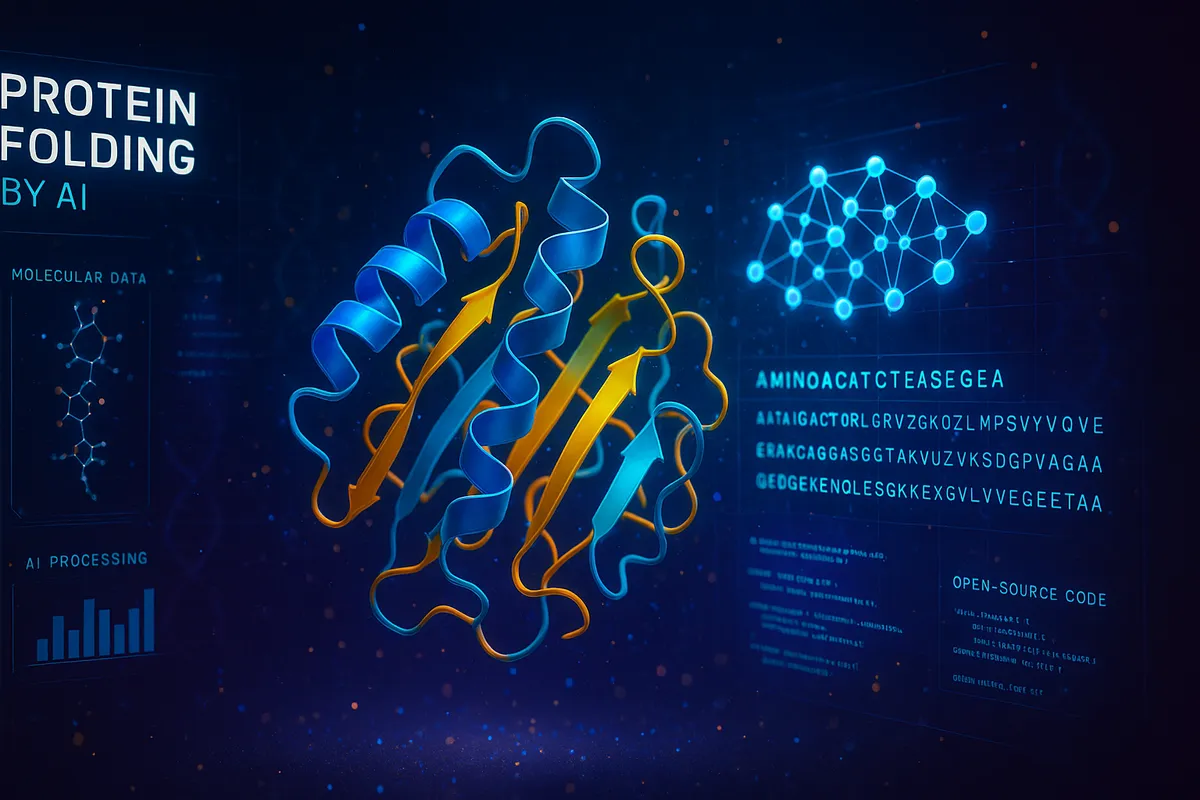
The quest for understanding the complex world of proteins has just taken a significant leap forward with the introduction of OpenFold3, an open-source artificial intelligence (AI) model designed to predict the 3D structures of proteins. This development is crucial because proteins are the building blocks of life, and their structures determine their functions, which in turn affect virtually every aspect of biology and medicine.
Developed by the OpenFold Consortium, a non-profit collaboration of academic and private research groups, OpenFold3 uses amino acid sequences to map the 3D structures of proteins and model their interactions with other molecules, such as drugs or DNA. This capability is not just a novelty; it has profound implications for drug discovery, disease research, and our overall understanding of biological processes.
The release of OpenFold3 is part of a broader movement towards democratizing access to AI tools in structural biology, a field that has seen significant advancements with the introduction of AlphaFold3 by Google DeepMind in May 2024. However, AlphaFold3 initially launched without sharing its underlying code, drawing criticism from researchers. While DeepMind later released the code for academic use in November 2024, it remains unavailable for commercial applications. This has spurred the development of fully open-source alternatives like OpenFold3, which can be used by any researcher or pharmaceutical company without restrictions.
OpenFold3 was trained on over 300,000 molecular structures and a synthetic database of more than 40 million structures, at a cost of $17 million. While it still lags slightly behind AlphaFold3 in terms of performance, the OpenFold Consortium is eager to gather feedback from the research community to improve the model. The preview release of OpenFold3 is an invitation to researchers to test, provide feedback, and integrate the tool into their workflows, paving the way for a full release in the coming months.
This move reflects broader industry trends towards openness and collaboration in AI research, driven by the belief that shared progress can lead to faster breakthroughs. As Stephanie Wankowicz, a computational structural biologist, expresses her excitement to test OpenFold3 and compare it to existing models, it’s clear that the scientific community is eager to leverage these tools to advance our understanding of proteins and their roles in health and disease.
The development and release of OpenFold3 underscore the critical role that open-source initiatives play in accelerating scientific discovery. By making powerful tools like OpenFold3 accessible to all, we can expedite the pace of innovation, driving towards a future where the complexities of protein folding are no longer a barrier to understanding the intricacies of life.
Tags :
Share :
Stay Ahead in Tech
Join thousands of developers and tech enthusiasts. Get our top stories delivered safely to your inbox every week.
No spam. Unsubscribe at any time.