OpenAI Finally Crosses the Rubicon: Ads Are Coming to ChatGPT
- Turker Senturk
- AI
- 23 Jan, 2026
- 8 min read
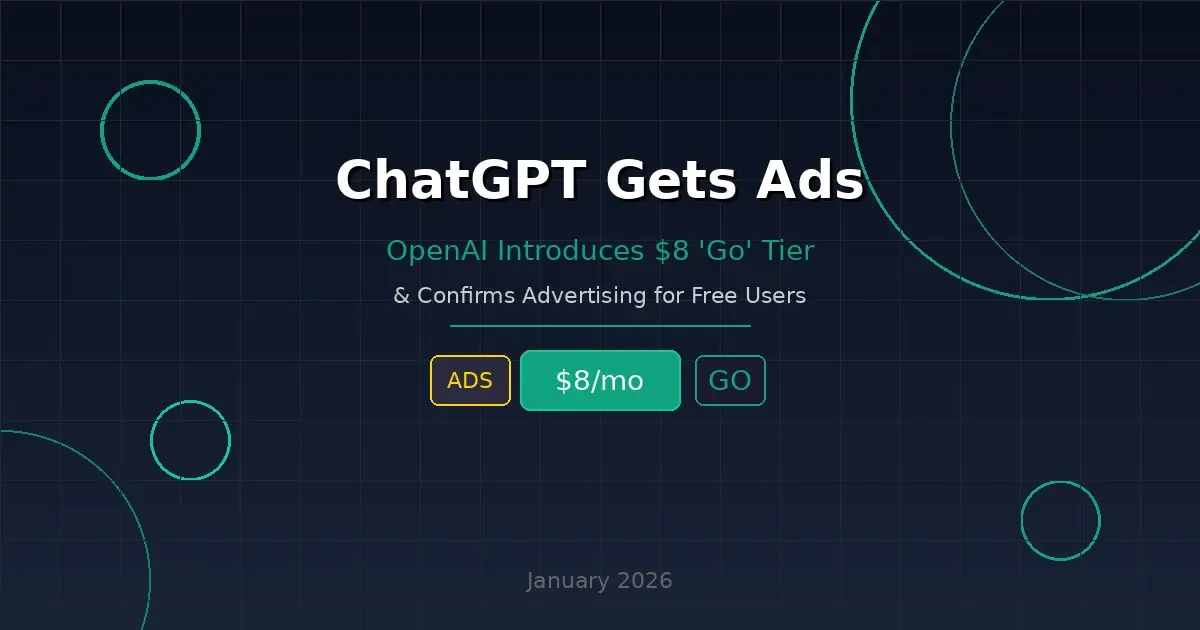
Well, it finally happened. After months of speculation, denials, and what can only be described as corporate tap-dancing around the subject, OpenAI has confirmed what many suspected was inevitable: advertisements are coming to ChatGPT. The announcement, made on January 16, 2026, also brought some good news — a new budget-friendly subscription tier called ChatGPT Go is now available worldwide for just $8 per month.
Let’s unpack what this means for the 800 million people who use ChatGPT every week, and why this might be the most significant pivot in OpenAI’s relatively short but incredibly eventful history.
The New Kid on the Block: ChatGPT Go
Remember when your streaming service of choice offered one simple plan? Those were simpler times. OpenAI is now serving up a full menu of subscription options, and ChatGPT Go sits right in the sweet spot between “free but limited” and “premium but pricey.”
Here’s what $8 a month gets you:
- 10x more messages, file uploads, and image generations compared to the free tier
- Access to GPT-5.2 Instant, the same speedy model available to free users
- Extended memory and context windows, meaning ChatGPT remembers more about you for longer
- The ability to create and customize your own GPTs
Think of it as the AI equivalent of a gym membership that actually lets you use the equipment without waiting in line. The free tier has always felt a bit like being handed a smartphone with a 2-hour daily screen time limit — technically functional, but frustratingly constrained.
ChatGPT Go first launched in India back in August 2025 at approximately ₹399 per month (around $4.40), and has since expanded to 171 countries. OpenAI claims it’s become their fastest-growing plan, which probably explains why they’re now rolling it out globally with adjusted pricing.
For context, here’s how the subscription tiers now stack up:
| Tier | Price | What You Get |
|---|---|---|
| Free | $0 | Basic access, strict limits, GPT-5.2 Instant |
| ChatGPT Go | $8/month | 10x more usage, longer memory, GPT-5.2 Instant |
| ChatGPT Plus | $20/month | GPT-5.2 Thinking, advanced reasoning, Codex agent |
| ChatGPT Pro | $200/month | Full GPT-5.2 Pro access, maximum everything |
The sharp-eyed among you will notice something: Go doesn’t include access to GPT-5.2 Thinking, the model designed for complex reasoning tasks. If you need the AI equivalent of a chess grandmaster analyzing your quarterly reports, you’ll still need to shell out for Plus or higher.
The Elephant in the Chat Room: Advertising
Now for the part that’s going to generate approximately 47% excitement and 53% existential dread among users: ads are coming.
Starting in the coming weeks, OpenAI will begin testing advertisements in the United States for users on the free tier and ChatGPT Go. Here’s how it’s supposed to work:
Where ads will appear: At the bottom of ChatGPT’s responses when there’s a relevant sponsored product or service based on your current conversation. Ask about planning a trip to Santa Fe? You might see an ad for a local cottage rental below the AI’s suggestions.
What OpenAI promises:
- Ads will be clearly labeled and visually separated from ChatGPT’s actual answers
- You can dismiss any ad and tell OpenAI why you didn’t want to see it
- You’ll be able to see why you’re being shown a particular ad
- Personalization can be turned off if you prefer generic ads (or fewer relevant ones, depending on your perspective)
What’s explicitly off-limits:
- No ads for users under 18
- No ads near sensitive topics like health, mental health, or politics
- No selling your conversation data to advertisers
- No influence on ChatGPT’s actual responses
And here’s the kicker: paid subscribers at the Plus, Pro, Business, and Enterprise levels will remain completely ad-free. So if the thought of seeing sponsored content between your AI-generated poetry and meal planning makes you uncomfortable, there’s a clear escape hatch — it just costs $20 or more per month.
The Five Commandments of OpenAI Advertising
OpenAI clearly knows this is a delicate move. They’ve outlined five principles that will supposedly guide their advertising approach:
-
Mission alignment: Advertising supports making AI accessible to everyone, aligning with their mission to benefit humanity. (Cynics might call this the “we need money to save the world” principle.)
-
Answer independence: This is the big one. OpenAI emphatically states that ads will never influence what ChatGPT tells you. The responses remain optimized for helpfulness, not ad revenue.
-
Conversation privacy: Your chats stay private from advertisers. OpenAI won’t sell your data. Period.
-
Choice and control: You can turn off personalization and clear ad-related data anytime. There will always be an ad-free option (though it costs money).
-
Long-term value: OpenAI claims they don’t optimize for time spent in ChatGPT. They prioritize user trust over revenue.
Whether you believe these principles will hold up under the pressure of quarterly revenue targets is another matter entirely. History has shown that advertising-dependent platforms tend to develop an unfortunate case of scope creep when it comes to data usage and ad placement.
Why Now? The Economics of Running an AI Giant
Let’s be honest: this move isn’t happening in a vacuum. Running one of the world’s most popular AI services isn’t cheap. We’re talking about server farms that could power small countries, GPUs that cost more than luxury cars, and research teams that rival the brightest minds at any university.
OpenAI’s reported operating expenses are in the billions. Sam Altman, OpenAI’s CEO, famously described advertising as a “last resort” back in October 2024. Fast forward to December 2025, and the company issued a “code red” directive, redirecting all resources to improving ChatGPT’s core functionality while explicitly delaying advertising and other revenue initiatives.
That delay didn’t last long. The pressure to monetize 800 million monthly active users — most of whom use the service for free — eventually became impossible to resist.
Consider the competitive landscape: Google and Meta together pull in hundreds of billions in advertising revenue annually. Amazon has been experimenting with AI-powered conversational ads. Even Google recently expanded AI Overview ads to 11 countries. The message is clear: if you’re building a platform with massive reach, advertising isn’t just an option — it’s expected.
What This Means for the AI Industry
OpenAI’s advertising move could be a watershed moment for the entire AI industry. Here’s why:
The free-tier monetization model is being tested. If OpenAI can successfully integrate ads without driving users away, expect Anthropic, Google, and others to follow suit. The race to make AI universally accessible while still paying the bills is on.
The trust factor becomes critical. OpenAI’s promise that ads won’t influence responses is essentially asking users to take a leap of faith. If users start suspecting that ChatGPT is recommending products because of ad deals rather than genuine helpfulness, the platform’s credibility could evaporate faster than you can say “sponsored content.”
The premium tier becomes more valuable. There’s a certain irony here: by introducing ads, OpenAI has actually made their paid subscriptions more attractive. Paying $20/month for Plus suddenly feels less like a luxury and more like buying your way out of the ad experience — similar to what’s happened with streaming services.
The Interactive Ad Twist
Here’s something interesting that hasn’t gotten as much attention: OpenAI’s announcement hints at ads that are more than just static banners. Users might be able to “directly ask the questions you need to make a purchase decision” within the ad experience.
Imagine this scenario: You ask ChatGPT about the best running shoes for flat feet. An ad appears for a shoe brand. Instead of just clicking through to their website, you can actually chat with an AI bot aligned with that advertiser to get specific product information.
It’s conversational commerce taken to its logical extreme. And while it sounds convenient in theory, it also raises questions about where the helpful AI assistant ends and the sales chatbot begins.
The Road Ahead
OpenAI has framed this announcement as part of their commitment to making AI accessible to everyone. And to their credit, the combination of a cheaper subscription tier and ad-supported free usage does lower barriers to entry.
But there’s a tension here that won’t go away: the more successful advertising becomes as a revenue stream, the more pressure there’ll be to expand it. The principles OpenAI has outlined are admirable, but principles have a funny way of becoming guidelines, and guidelines have a funny way of becoming suggestions.
For now, users have choices. Don’t want ads? Pay for Plus. Want to dip your toes into premium features without the full $20 commitment? Go for ChatGPT Go. Prefer to pay with your attention rather than your wallet? The free tier with ads is waiting for you.
What happens next will depend on user feedback, advertiser interest, and OpenAI’s ability to walk the tightrope between monetization and maintaining the trust that made ChatGPT a phenomenon in the first place.
One thing is certain: the era of ad-free AI for the masses is coming to an end. Whether that’s a necessary evolution or a Faustian bargain remains to be seen.
Sources
- OpenAI - Our approach to advertising and expanding access to ChatGPT
- OpenAI - Introducing ChatGPT Go, now available worldwide
- MacRumors - ChatGPT Introduces Lower-Priced Subscription Tier, Ads Coming Soon
- Digital Watch Observatory - ChatGPT and the rising pressure to commercialise AI
- PPC Land - OpenAI finally pulls trigger on ChatGPT ads after monthslong delay
Share :
Stay Ahead in Tech
Join thousands of developers and tech enthusiasts. Get our top stories delivered safely to your inbox every week.
No spam. Unsubscribe at any time.