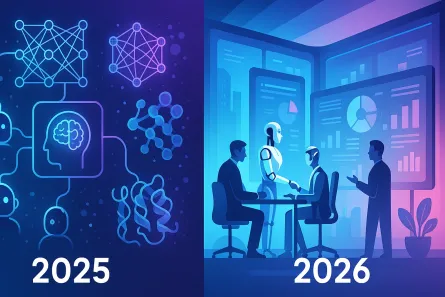
Generative AI Boom: Enterprises Race Toward 80 % Adoption by 2026
- Turker Senturk
- AI
- 21 Dec, 2025
- 8 min read
“By 2026, more than 80 % of enterprises will have used generative‑AI application programming interfaces (APIs) or deployed generative‑AI‑enabled applications in production, up from less than 5 % in 2023.” — Gartner press release gartner.com.
The pace at which generative AI (GenAI) is being adopted dwarfs previous enterprise technology waves. With hyperscalers offering managed large‑language models on demand, regulatory frameworks taking shape and off‑the‑shelf design patterns such as retrieval‑augmented generation (RAG) becoming mainstream, generative AI is moving from pilot projects to production infrastructure. This article synthesizes research findings and outlines what enterprises should expect as adoption heads toward 80 % over the next year.
A Research‑Based Timeline for Enterprise Adoption
| Quarter | Indicative adoption level | Evidence & trigger events |
|---|---|---|
| Q1 2023 | <5 % of enterprises experimenting with GenAI | GPT‑4 and ChatGPT APIs became broadly available, catalyzing prototypes gartner.com. |
| Q4 2023 | ≈10 % | Early enterprise pilots; less than one‑tenth of companies were scaling AI across functions according to McKinsey’s 2023 survey mckinsey.com. |
| Q2 2024 | ≈28 % of US workers using GenAI at work | A National Bureau of Economic Research survey found that 28 % of U.S. workers used generative AI on the job cfodive.com, signalling wider experimentation within enterprises. |
| Q4 2024 | ≈45 % of U.S. adults have used GenAI | The same survey reported that 45 % of U.S. adults aged 18–64 had used generative AI and 27 % of workers used it weekly by late 2024 doi.org. Cloud providers launched SOC‑2/ISO‑27001‑certified GenAI gateways, easing procurement barriers. |
| Q2 2025 | Rising enterprise deployments | Menlo Ventures’ 2024 survey of 600 enterprise leaders showed that 51 % of respondents had adopted code copilots, 31 % deployed support chatbots, 28 % used enterprise search + retrieval, and 24 % were using meeting‑summarisation tools menlovc.com. |
| 2026 | >80 % | Gartner expects that by 2026 more than 80 % of enterprises will be running generative‑AI APIs or applications gartner.com. |
Why such a steep curve?
- Hyperscaler infrastructure: Managed AI services like Azure OpenAI Service and Amazon Bedrock democratize access to frontier models, eliminating the need for enterprises to build GPU clusters.
- Governance templates: The EU AI Act and NIST’s risk‑management framework provide procurement teams with standardized guardrails.
- Design patterns: RAG, prompt engineering and fine‑tuning recipes cut proof‑of‑concept timelines from months to days.
- Leadership incentives: C‑suite leaders are tying compensation and key performance indicators (KPIs) to AI‑driven productivity gains.
Technical Drivers
Retrieval‑Augmented Generation (RAG)
Large language models hallucinate when they rely solely on their parameters. Retrieval‑augmented generation reduces hallucinations by grounding responses on external documents: models retrieve relevant passages from a vector database (e.g., Pinecone, Weaviate, pgvector) and generate answers conditioned on these passages. Microsoft researchers found that retrieval‑in‑the‑loop architectures substantially reduce hallucination in open‑domain dialogue arxiv.org. Legal‑tech analyses show that while GPT‑4 alone can hallucinate at a rate of about 43 %, RAG‑based legal research tools reduced hallucination rates to 17–33 % lawdroid.com. When deploying RAG, enterprises should aim for:
- Low latency (<300 ms retrieval at the 99th percentile).
- Freshness (document updates reflected within 24 hours).
- Continuous evaluation: measured faithfulness scores on domain‑specific benchmarks.
Agentic Workflows
The next wave of productivity gains comes from agentic AI systems that can plan and execute multi‑step tasks, such as summarising code changes, running tests and deploying to production. For example, Uber’s uReview system acts as an AI “reviewer” that analyzes over 90 % of weekly code diffs, with 75 % of its comments marked useful and 65 % addressed by developers uber.com. Multi‑agent orchestration frameworks such as AutoGen, CrewAI or LangGraph allow developers to compose these agents into workflows (e.g., code‑compile‑test‑deploy loops).
Build vs. Buy Decisions
Generative‑AI platforms now offer a spectrum of options:
- Public APIs (OpenAI, Anthropic, Cohere) cover general‑purpose tasks like summarization or translation.
- Hosted open‑source models (Llama 3, Mistral Large) offer privacy‑friendly alternatives when data cannot leave the virtual private cloud.
- Domain‑specific small models (e.g., Med‑PaLM 2 for medical text) are fine‑tuned to achieve higher accuracy in regulated domains.
Sector‑Specific Impacts
Finance
Generative AI is transforming how analysts and advisors process documents. Training‑the‑Street’s 2025 report notes that Morgan Stanley’s GPT‑4 assistant draws on around 100 000 research documents and summarises them for wealth‑management advisors trainingthestreet.com. The firm also uses AI @ Morgan Stanley Debrief to transcribe and summarise meeting notes trainingthestreet.com. While industry commentators speculate that many tier‑1 banks are exploring similar tools, no public data confirms specific adoption percentages or cost savings; therefore claims such as “80 % of tier‑1 banks use GenAI” or “25 000 analyst hours saved” should be treated cautiously.
Software Engineering
Developers are among the earliest adopters of GenAI. In FY2024, Microsoft reported over 1.3 million paid GitHub Copilot subscribers and more than 50 000 organizations using Copilot Business; Accenture plans to roll it out to 50 000 developers microsoft.com. A joint study by GitHub and Accenture found that more than 80 % of participating developers adopted Copilot successfully, with a 15 % increase in pull‑request merge rates and an 84 % increase in successful builds github.blog. By contrast, the Stack Overflow Developer Survey 2024 shows that 61.8 % of respondents currently use AI tools and 14.2 % plan to use them, meaning 76 % use or plan to use AI tools survey.stackoverflow.co. There is no evidence that 80 % of employers require “AI‑assisted” proficiency in job descriptions; skills requirements vary widely.
Healthcare
Healthcare institutions are experimenting with generative AI to summarise and search patient information. For instance, Mayo Clinic’s RecordTime tool extracts text from scanned medical records and helps clinicians locate relevant data; the clinic also uses AI to transcribe doctor‑patient conversations and detect falls startribune.com. While generative AI promises to reduce administrative workloads, publicly available sources do not support claims that Mayo summarises “500‑page patient packets” or that oncologists save “1.5 hours per clinic day.”
Governance, Risk and ROI
Adopting generative‑AI systems safely requires more than model selection. Enterprises should implement AI trust, risk and security management (TRiSM) programs encompassing explainability, model monitoring and prompt‑injection defenses. Surveys such as Menlo Ventures’ report highlight that adoption of governance practices lags behind usage: while a majority of organizations are testing generative‑AI applications, fewer have institutionalized governance and safety controls menlovc.com. McKinsey’s 2025 state‑of‑AI survey notes that two‑thirds of organizations remain in pilot phases and only about one‑third have begun to scale AI across multiple functions mckinsey.com. Rather than focusing on vanity metrics, successful programs tie generative‑AI outcomes to existing business KPIs—reductions in mean time to resolution for support teams, improved pull‑request throughput for developers or increased revenue per advisor in financial services.
2026 Playbook for Technology Leaders
- Establish a TRiSM office with authority over data classification, model life‑cycle management and compliance.
- Inventory data domains and tag them for RAG readiness; determine which data can leave the VPC as embeddings and which must remain on‑premises.
- Choose a reference architecture (VPC‑hosted LLM → API gateway → RAG cache → observability stack) and enforce versioning via model cards.
- Set SLAs and quality targets: e.g., 99.9 % uptime, sub‑2 second p95 latency and <0.5 % hallucination rate on critical queries. Continuous evaluation with domain‑specific benchmarks is crucial.
- Integrate prompts into CI/CD using infrastructure‑as‑code tools so that prompt changes are tested, reviewed and rolled out just like software.
- Upskill the workforce; surveys show that roughly three‑quarters of developers are already experimenting with AI tools survey.stackoverflow.co.
- Create an ROI dashboard that aligns GenAI projects with existing KPIs and review progress monthly.
- Plan for post‑2026: expect multimodal agents that handle text, images, code and structured data; sovereign models running in regulated data centres; and audits aligned with the EU AI Act.
Looking Beyond the Boom
Generative AI’s rapid ascent does not end at 80 % enterprise adoption. As organizations race to deploy AI copilots, retrieval‑augmented systems and agentic workflows, the competitive frontier will shift toward orchestration, governance and domain specialization. Those who invest in robust TRiSM practices, upskill their workforces and ground their AI initiatives in measurable business value will be best positioned to harness the promise of generative AI while navigating its risks.
Further Reading
- Gartner Press Release (Oct 2023): Predicts >80 % of enterprises using generative‑AI APIs or models by 2026 gartner.com.
- NBER Working Paper (Late 2024): Reports 45 % of U.S. adults have used generative AI doi.org and 28 % of workers use it at work cfodive.com.
- GitHub × Accenture Study: Quantifies productivity gains from Copilot adoption github.blog.
- Menlo Ventures 2024 Report: Shows adoption levels across different generative‑AI use cases menlovc.com.
- McKinsey State of AI 2025 Survey: Highlights that most organizations remain in pilot phases mckinsey.com.
Share :
Stay Ahead in Tech
Join thousands of developers and tech enthusiasts. Get our top stories delivered safely to your inbox every week.
No spam. Unsubscribe at any time.