Dyson 2025: Sensor-Driven Vacuums, Smarter Purifiers, and a New Recycling Initiative
- Turker Senturk
- Technology
- 05 Jan, 2026
- 10 min read
Dyson has been busy throughout 2025, rolling out significant updates to its flagship product lines. The British technology company, known for its premium approach to home appliances, has introduced the V15 Detect Absolute Pro cordless vacuum, expanded its air purifier range with enhanced sensor technology, and launched a global trade-in and recycling program. These moves signal Dyson’s commitment to making home cleaning not just more powerful, but genuinely smarter.
Let’s break down what’s new and whether these premium-priced products are worth your attention.
The Dyson V15 Detect Absolute Pro: When Your Vacuum Becomes a Scientist
The V15 Detect series has been Dyson’s flagship cordless vacuum for a few years now, but the latest Absolute Pro variant pushes the sensor-driven cleaning concept even further. This isn’t just about raw suction power—though there’s plenty of that—it’s about giving you real-time data on what your vacuum is actually picking up.
What Makes It Special
The standout feature remains the piezo sensor technology. This acoustic sensor continuously measures the size and quantity of dust particles being sucked into the vacuum, displaying the information on an LCD screen in real-time. When the sensor detects more debris, the vacuum automatically increases suction power. When the floor is clean, it backs off to conserve battery life.
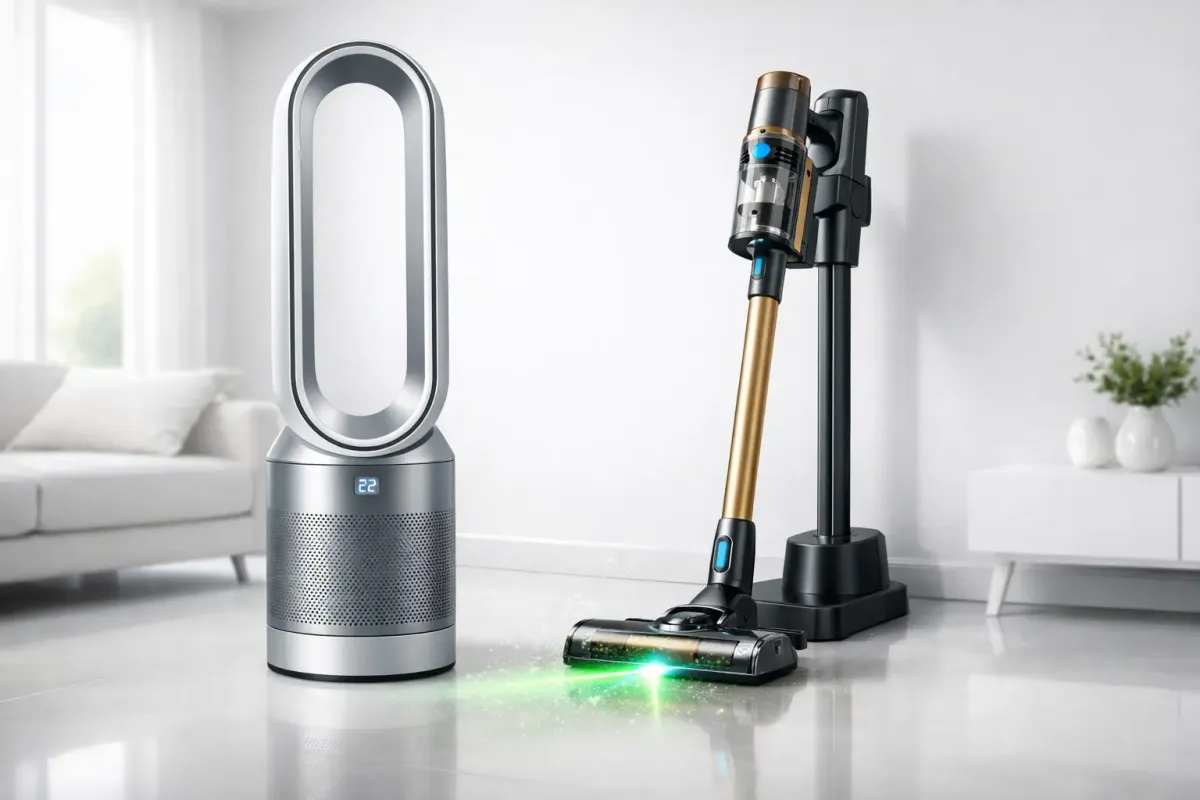
The laser-illuminated hard floor head is another clever touch. A precisely angled green laser makes microscopic dust visible on hard surfaces that would otherwise look perfectly clean. It’s surprisingly satisfying—and slightly disturbing—to see just how much invisible dust exists on floors you thought were spotless.
Key Specifications
| Feature | Dyson V15 Detect Absolute Pro |
|---|---|
| Motor Speed | Up to 125,000 RPM (Hyperdymium motor) |
| Sealed Suction | 124 inches of water lift (highest in independent tests) |
| Run Time | Up to 60 minutes (Eco mode) |
| Dust Bin Capacity | 0.76 liters |
| Filtration | HEPA H13 (captures 99.97% @ 0.3 microns) |
| Smart Features | Piezo particle sensor, LCD display, auto-adjust suction |
| Floor Heads | Fluffy Optic (laser), Digital Motorbar (anti-tangle) |
| Weight | Approximately 3 kg |
| Price | ~$699-749 USD / £649 GBP |
According to independent testing by Vacuum Wars, the V15 Detect still holds the highest sealed suction score among all cordless vacuums they’ve evaluated, measuring 124 inches of water lift. This beats even Dyson’s newer Gen5 Detect at 112 inches.
Real-World Performance
In practical testing reported by Popular Mechanics, the V15 Detect Absolute handled everything from fine dust on laminate floors to Cheerios wedged between couch cushions without breaking a sweat. Real-world battery life typically falls between 35-45 minutes on Auto/Medium mode—less than the advertised 60 minutes, but that’s normal since the maximum runtime assumes consistent Eco mode usage on hard floors.
The Digital Motorbar cleaner head includes de-tangling vanes that automatically clear wrapped hair from the brush bar as you clean. This is genuinely useful for homes with long-haired humans or pets.
How It Compares to Competitors
| Vacuum Model | Price | Key Technology | Particle Sensing | Sealed Suction |
|---|---|---|---|---|
| Dyson V15 Detect Absolute | ~$749 | Piezo sensor, laser floor head | Yes (real-time) | 124” water lift |
| Dyson Gen5 Detect | ~$949 | Upgraded motor, button control | Yes | 112” water lift |
| Shark AI Robot Vacuum 2 | ~$500 | AI mapping, self-empty | No | Not comparable (robot) |
| Roborock S8 | ~$600 | LiDAR mapping | No | Not comparable (robot) |
| Miele Triflex HX2 | ~$700 | 3-in-1 design, swappable battery | No | ~90” water lift |
The V15’s unique selling point remains its sensor-driven suction intelligence. Competitors have caught up on AI mapping and voice control for robot vacuums, but nobody else combines particle-size sensing with automatic suction adjustment in a stick vacuum.
Dyson Air Purifiers: The TP07 and HP09 Family
Dyson’s latest air purifiers continue the company’s strategy of combining multiple functions—purification, cooling, and in some models, heating—into a single device. The TP07 (fan + purifier) and HP09 (adds heating and formaldehyde removal) represent the current top tier of their lineup.
What’s Actually Different
The TP07 has been re-engineered to deliver what Dyson claims is 50% cleaner air compared to the original Pure Cool TP01. The key improvements center around the fully sealed HEPA H13 filtration system and enhanced air quality sensors.
These purifiers use a laser particle sensor that detects particles as small as PM0.1 and feeds data to both an LCD screen and the Dyson Link app. The auto-mode adjusts fan speed and filtration intensity based on real-time air quality readings, which is genuinely useful if you don’t want to manually monitor your indoor air.
Technical Breakdown
| Model | Function | Filtration | Smart Features | Room Coverage | Price |
|---|---|---|---|---|---|
| TP07 | Purifier + Fan | HEPA H13 + Activated Carbon | LCD, app, Alexa/Google/HomeKit | Up to 2,860 sq ft | ~$649 USD |
| HP04 | Purifier + Fan + Heater | HEPA H13 + Activated Carbon | LCD, app, voice control | Similar coverage | ~$799 USD |
| HP09 | Purifier + Fan + Heater + Formaldehyde | HEPA H13 + Catalytic oxidation | Full smart suite | Similar coverage | ~$1,099 USD |
The HP09’s standout feature is Selective Catalytic Oxidation technology for formaldehyde removal. Unlike activated carbon filters that eventually saturate, this catalytic process continuously breaks down formaldehyde molecules into water and CO2. This is particularly relevant for newer homes or renovated spaces where off-gassing from materials is a concern.
The CADR Question
Here’s where Dyson gets some criticism. CADR (Clean Air Delivery Rate) measures how quickly a purifier can clean air in a standardized space. Dyson doesn’t prominently advertise CADR figures, and independent tests suggest their purifiers lag behind similarly priced competitors in raw airflow efficiency.
| Purifier | Approximate CADR | Price | Strengths |
|---|---|---|---|
| Dyson TP07 | ~160 m³/h | ~$649 | Design, smart integration, 360° rotation |
| Blueair Classic 680i | ~400 m³/h | ~$500 | Higher airflow, simpler operation |
| Coway Airmega 400S | ~350 m³/h | ~$600 | Strong CADR, smart features |
| Levoit Core 600S | ~200 m³/h | ~$200 | Budget-friendly, app control |
If raw air cleaning speed is your priority, there are more cost-effective options. However, Dyson leads on smart-home integration, design aesthetics, and specific features like formaldehyde removal. The 350-degree oscillation also helps with air circulation in ways that static purifiers don’t match.
Smart Home Integration
The TP07 and HP09 are the most connected Dyson purifiers to date. Beyond the Dyson Link app (which provides historic AQI trends, filter life tracking, and remote control), they support:
- Amazon Alexa voice commands
- Google Assistant integration
- Apple HomeKit shortcuts
- Over-the-air firmware updates
For households already invested in a smart home ecosystem, this level of integration is valuable. You can set up automations that trigger the purifier based on time of day, other sensor readings, or when you arrive home.
Dyson’s Trade-In and Recycling Program: A Step Toward Circularity
Dyson launched a global trade-in and recycling program in 2025, allowing customers to send back any Dyson appliance for free recycling while receiving a discount (typically around 10%) on new purchases.
How It Works
- Registration: Customers check online or in-store whether their device is eligible
- Return: Devices are sent back via prepaid shipping labels (DHL in many regions)
- Assessment: Dyson evaluates the condition for refurbishment or recycling
- Discount: Customers receive credit toward new purchases
- Processing: Working devices may be refurbished for Dyson Renewed; others are recycled according to e-waste regulations
The program accepts appliances regardless of condition—even broken devices qualify for the recycling component, though discount amounts vary based on the product being traded.
Why This Matters
Several factors make this initiative notable:
Breadth of Coverage: This isn’t limited to vacuums. The program covers fans, purifiers, and hair care products—essentially Dyson’s entire product range.
Environmental Compliance: Devices are processed according to EU WEEE (Waste Electrical and Electronic Equipment) regulations, ensuring proper material recovery and hazardous component handling.
Brand Control: By bringing old products back into their system, Dyson maintains more control over the secondary market and can ensure quality standards for refurbished units.
ESG Positioning: With growing investor and consumer interest in sustainability, formalized recycling programs help companies demonstrate environmental responsibility.
The Realistic Take
Let’s be clear: trade-in programs aren’t charity. Dyson benefits from reduced competition from secondhand markets, access to parts for repairs, and positive brand perception. The 10% discount is modest compared to typical promotional sales.
That said, the program does provide genuine value for consumers who:
- Have old Dyson devices they can’t easily sell or donate
- Want assurance that electronics are being properly recycled
- Were planning to buy a new Dyson product anyway
For eco-conscious buyers, this is a meaningful differentiator from brands that have no formalized take-back process.
The Bigger Picture: What Dyson’s 2025 Strategy Reveals
Looking across these product launches and initiatives, several strategic themes emerge:
Sensor-Centric Intelligence
Both the V15 vacuum and the latest purifiers embed particle-size sensors that feed live data to users and drive autonomous performance adjustments. This isn’t just a gimmick—it represents Dyson’s bet that data-driven cleaning will become a key differentiator across categories.
Premium Price Consolidation
New products sit firmly in the $600-$1,100 bracket, reinforcing Dyson’s positioning as a luxury-tech brand rather than a mass-market player. The company appears comfortable defending this niche through ecosystem integration (Dyson Link app, trade-in incentives) rather than competing on price.
Cross-Category Ecosystem
By aligning vacuums, fans, purifiers, and the app under a single platform, Dyson is building what could eventually host additional services—subscription filter delivery, indoor air quality analytics, or integration with home health systems.
Sustainability as Strategy
The recycling program, while not technologically revolutionary, signals awareness of ESG expectations from investors and corporate buyers. It may also influence procurement decisions in enterprise or institutional contexts.
Who Should Consider These Products?
The V15 Detect Absolute Pro Is For:
- Tech-savvy homeowners who appreciate data and automation
- Pet owners dealing with hair and dander
- People willing to pay premium prices for genuinely innovative features
- Those who want the best suction performance in a cordless format
The TP07/HP09 Air Purifiers Are For:
- Health-conscious families and allergy sufferers
- Smart-home enthusiasts who value integration over raw performance
- Buyers who prioritize design and multifunctionality
- Those concerned specifically about formaldehyde (HP09)
The Trade-In Program Makes Sense If:
- You have old Dyson devices collecting dust
- You were already planning to purchase new Dyson products
- Proper recycling is important to you
- You want a hassle-free disposal process
Final Thoughts
Dyson’s 2025 lineup doesn’t reinvent home cleaning, but it does push the sensor-driven intelligence concept further than any competitor. Whether that justifies the premium prices depends on how much you value real-time cleaning data, smart-home integration, and the Dyson design aesthetic.
For those already in the Dyson ecosystem, these products represent meaningful upgrades. For newcomers, they’re an expensive entry point—but one that delivers genuinely differentiated technology rather than just brand prestige.
The trade-in program, meanwhile, addresses a real problem with responsible electronics disposal while serving Dyson’s business interests. It’s the kind of initiative that benefits everyone involved, even if the motivations aren’t purely altruistic.
Sources
- Dyson Official - V15 Detect Product Page
- Vacuum Wars - Dyson V15 Detect 2025 Awards
- Popular Mechanics - Dyson V15 Detect Absolute Review
- TechRadar - Dyson V15 Detect vs Gen5detect
- Dyson Official - Purifier Cool TP07
- HouseFresh - Dyson Purifier Cool TP07 Review
- Modern Castle - Dyson TP07 Review
- Uchify - Dyson Trade-In Programme
- Koorvi - Dyson Trade-In Analysis
- Reviews.org - Dyson Trade-In Overview
Share :
Stay Ahead in Tech
Join thousands of developers and tech enthusiasts. Get our top stories delivered safely to your inbox every week.
No spam. Unsubscribe at any time.