Database Systems and Comparisons in 2025: The Ultimate Guide to Choosing Your Data Home
- Turker Senturk
- Software
- 13 Jan, 2026
- 16 min read
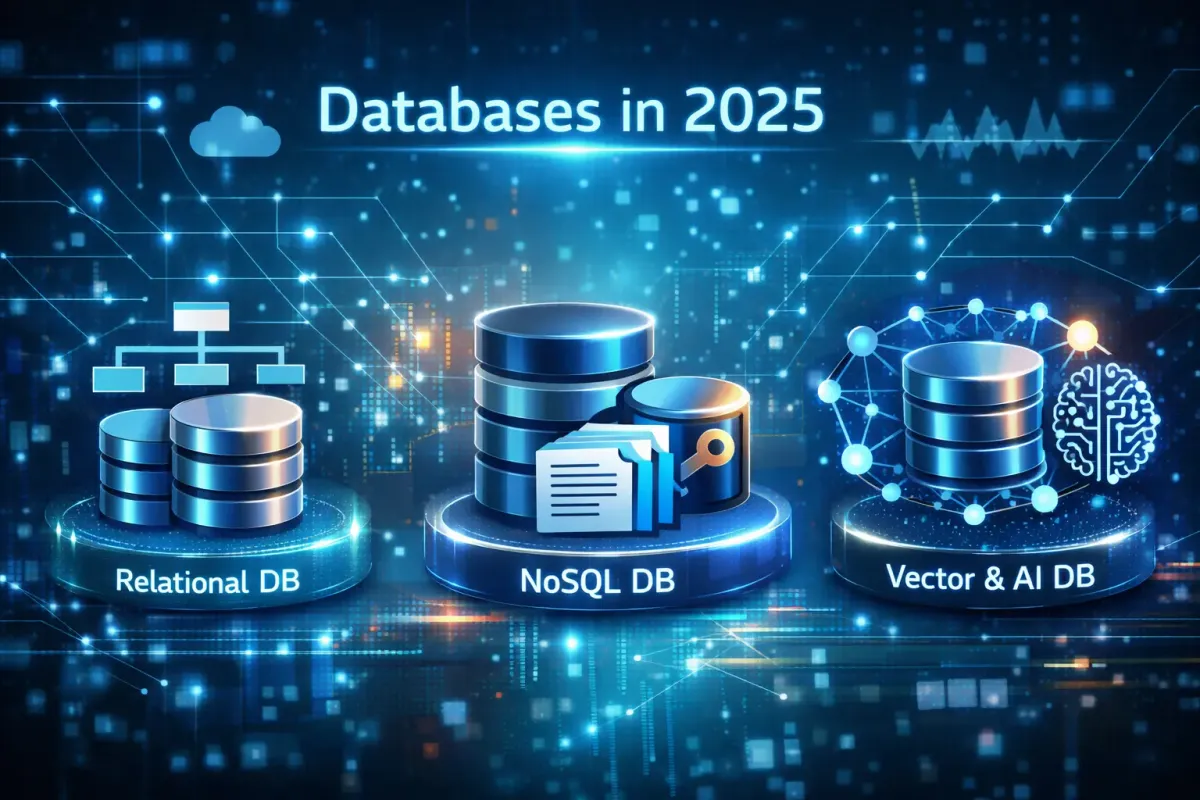
Remember when picking a database was as simple as choosing between Oracle or MySQL? Yeah, those days are gone. In 2025, the database landscape looks less like a simple menu and more like an all-you-can-eat buffet with cuisines from every corner of the tech world. We’ve got relational databases doing yoga to become more flexible, NoSQL systems putting on suits to look more enterprise-y, and entirely new categories like vector databases crashing the party to support our AI overlords.
Let’s dive into this fascinating world and figure out which database deserves a spot in your tech stack.
The State of the Union: Database Rankings in 2025
Every year, the DB-Engines popularity index gives us a snapshot of which databases are winning hearts and minds. Think of it as the Billboard Hot 100, but for data nerds. Here’s what the 2025 charts look like:
| Rank | Database | Type | Trend |
|---|---|---|---|
| 1 | Oracle | Relational | Rising |
| 2 | MySQL | Relational | Declining |
| 3 | Microsoft SQL Server | Relational | Declining |
| 4 | PostgreSQL | Relational | Rising |
| 5 | MongoDB | Document (NoSQL) | Declining |
| 6 | Snowflake | Cloud Data Warehouse | Rising |
| 7 | Redis | Key-Value Store | Slight Drop |
| 13 | Databricks | Cloud Analytics Platform | Significant Rise |
| 20 | Neo4j | Graph Database | Slight Rise |
A few things jump out from this table. Oracle is still the undisputed heavyweight champion, and it’s actually gaining ground. PostgreSQL is the scrappy open-source underdog that keeps climbing the ladder. Meanwhile, MySQL and MongoDB—once the darlings of the startup world—are showing their age like that band you loved in college but doesn’t quite hit the same anymore.
The real story, though, is the meteoric rise of Snowflake and Databricks. These cloud-native analytics platforms are eating everyone’s lunch because, let’s face it, companies want their data to not just sit there but actually tell them something useful. And with AI becoming as common as coffee machines in offices, platforms that can handle analytical and AI workloads are suddenly the cool kids at school.
The Great Debate: SQL vs. NoSQL in 2025
If database discussions were a Thanksgiving dinner, the SQL vs. NoSQL debate would be that argument between your uncle and your cousin that never really gets resolved. But here’s the thing: in 2025, this debate has matured from “which one is better” to “which one is better for what.”
Research shows that relational databases still power over 75% of enterprise deployments. That’s not because companies are stuck in the past—it’s because SQL databases are genuinely excellent at what they do. But NoSQL adoption keeps growing in specific niches where its strengths shine.
The SQL Way: Structure and Stability
SQL databases are like that friend who always has their life together. Everything has a place, there are rules, and those rules get followed.
What makes SQL databases tick:
They organize data into neat tables with predefined schemas—think of it as a spreadsheet where every column has a specific purpose and data type. They guarantee ACID transactions (Atomicity, Consistency, Isolation, Durability), which is a fancy way of saying “your data won’t get corrupted even if the power goes out mid-transaction.” They use a standardized query language that’s been around since the disco era but still works beautifully. And they typically scale vertically, meaning when you need more power, you get a bigger server.
The NoSQL Way: Flexibility and Freedom
NoSQL databases are the free spirits of the data world. They don’t care about your rigid schemas—they’ll store whatever you throw at them and figure it out later.
What makes NoSQL databases different:
They support flexible data models including documents (JSON-like structures), key-value pairs, wide columns, and graphs. They follow BASE consistency (Basically Available, Soft state, Eventually consistent), which trades some rigidity for speed and availability. They use dynamic schemas that can evolve as your application changes. And they’re designed for horizontal scaling, meaning you can add more servers instead of buying one massive machine.
When to Use What
Here’s a handy cheat sheet based on real-world patterns:
Go with SQL when:
Your application involves complex business logic and relationships—think e-commerce platforms where orders connect to customers connect to products connect to inventory. Data integrity is non-negotiable (financial systems, healthcare records). You need sophisticated analytics and reporting. Your team already knows SQL, and retraining costs time and money.
Go with NoSQL when:
You need to scale massively across many servers. Your data structure changes frequently (rapidly evolving startups, experimental features). You’re dealing with extremely high write throughput (IoT sensors, event logging, real-time tracking). Your data is geographically distributed and needs to be close to users worldwide.
Go hybrid (and most smart teams do):
The polyglot persistence approach is winning in 2025. This means using multiple databases, each optimized for specific tasks. PostgreSQL handles your core transactional data, Redis caches frequently accessed information, MongoDB stores flexible content, and ClickHouse crunches analytics. It’s like having a toolbox instead of just a hammer.
The Relational Champions: Old Dogs with New Tricks
Don’t let anyone tell you relational databases are dinosaurs. They’ve evolved, adapted, and in many cases, they’re thriving.
Oracle: The Enterprise King
Oracle didn’t stay at number one by accident. In 2025, Oracle has integrated AI-driven features like automatic indexing and intelligent workload management. Imagine a database that watches how you use it and then optimizes itself—that’s what Oracle is doing now. It’s like having a butler who learns your preferences and adjusts the house before you even ask.
Oracle’s mature ecosystem, rock-solid security, and multi-tenant architecture make it the go-to choice for organizations where “the database can never go down” isn’t a suggestion—it’s a requirement.
PostgreSQL: The People’s Champion
If databases had a fan favorite award, PostgreSQL would win every year. This open-source powerhouse has become the Swiss Army knife of databases, and its popularity keeps rising for good reason.
PostgreSQL supports advanced indexing, full-text search, native JSON (so you can be a little NoSQL-ish when needed), and incredible extensibility. Want to add geospatial capabilities? There’s an extension for that. Need vector search for AI? Yep, PostgreSQL can do that too.
What really sets PostgreSQL apart is its read-heavy workload performance. Through parallel query execution and sophisticated query planning, it can handle analytical queries that would make other databases break a sweat. While it traditionally scaled vertically, modern PostgreSQL offers horizontal scaling through logical replication, partitioning, and extensions like Citus.
The rising trust in PostgreSQL reflects a broader industry shift toward open-source solutions—organizations don’t want vendor lock-in, and they appreciate being able to peek under the hood.
MySQL: The Reliable Workhorse
MySQL is like that reliable pickup truck that just keeps running. It’s the most widely deployed open-source database, powering countless web applications, content management systems, and e-commerce platforms.
Its simplicity is both a feature and a selling point. MySQL doesn’t try to do everything—it focuses on being really good at what it does. The InnoDB storage engine delivers solid mixed read-write performance, and it runs beautifully even on modest hardware (your wallet will thank you).
Scaling options include read replicas, MySQL Cluster, and group replication. However, MySQL’s ranking is gradually declining as workloads become more diverse and developers seek more specialized solutions. It’s still excellent for its core use cases, but the market is fragmenting.
Microsoft SQL Server: The Enterprise Integration Powerhouse
If your organization runs on Microsoft, SQL Server fits like a glove. The 2025 release enhances cloud capabilities and includes features like columnstore indexes and in-memory OLTP that deliver exceptional analytical performance.
SQL Server’s Always On availability groups and Azure integration make it a natural choice for enterprises requiring seamless integration with Windows and Microsoft tools. It’s not trying to be everything to everyone—it’s being the best option for Microsoft-centric environments.
Feature Comparison: The Big Three
| Feature | PostgreSQL | MySQL | SQL Server |
|---|---|---|---|
| ACID Compliance | Full | Full | Full |
| JSON Support | Native | Native | Native |
| Full-Text Search | Built-in | Built-in | Advanced |
| Replication Options | Logical & Physical | Master-Slave, Group Replication | Always On Availability Groups |
| Licensing | Open Source | Dual (GPL & Commercial) | Commercial |
| Windows Integration | Good | Good | Excellent |
| Linux Support | Excellent | Excellent | Good |
NoSQL and Specialized Databases: The Specialists
While relational databases are generalists, NoSQL and specialized databases are like medical specialists—they do specific things exceptionally well.
MongoDB: The Document Database Pioneer
MongoDB revolutionized how developers think about databases by letting them work with data in JSON-like formats that match how applications actually structure objects. No more mapping objects to tables—just store them as they are.
Its flexible schema and aggregation pipeline make it perfect for content management, product catalogs, and user profiles. Need to scale? MongoDB’s sharding distributes data across multiple servers. It’s not trying to compete with PostgreSQL for complex transactional workloads—it’s winning at flexibility and developer experience.
Redis: The Speed Demon
Redis stores everything in memory, which means sub-millisecond response times. When your application needs to be fast—really fast—Redis is your friend.
It’s the go-to solution for caching (store frequently accessed data so your main database doesn’t get hammered), session management (keep user sessions alive), and real-time analytics. Redis supports various data structures including strings, lists, sets, and sorted sets, and Redis Cluster handles horizontal scaling when you outgrow a single server.
Amazon DynamoDB: Serverless NoSQL
DynamoDB offers consistent low-millisecond latency and automatic scaling without you having to think about server management. It’s a fully managed key-value and document store that shines for variable workloads—you pay for what you use, and it scales up and down automatically.
The catch? High throughput can get expensive. DynamoDB’s pricing model is friendly for unpredictable workloads but can surprise you when usage spikes.
Apache Cassandra: The Distributed Architecture Master
Cassandra’s masterless, wide-column architecture is built for massive scale and high availability. When you need a database that works across multiple data centers and continents without any single point of failure, Cassandra answers the call.
Its scalability is linear—add more nodes, get proportionally more performance. This makes it perfect for write-heavy workloads, IoT data ingestion, and time-series applications. The trade-off is tunable consistency; you decide how much consistency you need versus how much speed.
Neo4j: The Relationship Expert
Neo4j thinks in relationships. While other databases treat connections as an afterthought, Neo4j makes them first-class citizens. Its Cypher query language lets you express complex relationship patterns intuitively.
When do you need Neo4j? Recommendation engines (“customers who bought this also bought…”), fraud detection (finding suspicious patterns across networks of transactions), social networks (who knows whom knows whom), and knowledge graphs. If your queries involve traversing many relationships, Neo4j will outperform relational databases by orders of magnitude.
ClickHouse: The Analytics Powerhouse
ClickHouse is a column-oriented database that can process billions of rows per second. Yes, billions. It uses compression and vectorized execution to squeeze every drop of performance from modern hardware.
ClickHouse typically serves as the analytical layer for real-time dashboards and business intelligence. When you need to answer questions like “show me sales trends across all our products in all regions for the past five years, grouped by quarter,” ClickHouse delivers the answer before you finish reaching for your coffee.
Specialized Database Comparison
| Aspect | Cassandra | Neo4j | ClickHouse |
|---|---|---|---|
| Primary Use | Distributed Scale | Graph Relationships | Analytics |
| Data Model | Wide Column | Graph | Columnar |
| Query Language | CQL | Cypher | SQL |
| Scaling | Horizontal | Vertical/Horizontal | Horizontal |
| Consistency | Tunable | ACID | Eventual |
| Best For | IoT, Time-Series | Social, Recommendations | BI & Analytics |
NewSQL: The Best of Both Worlds
What if you could have the familiar SQL interface and ACID transactions of relational databases, but with the horizontal scalability of NoSQL? That’s the promise of NewSQL.
CockroachDB: Distributed SQL Pioneer
CockroachDB marries SQL familiarity with NoSQL-like horizontal scalability. It provides ACID transactions across distributed clusters (so your data stays consistent even when spread across multiple data centers) and eliminates single points of failure through a multi-active availability design.
If you need global consistency with distributed transactions and don’t want to give up SQL, CockroachDB is worth serious consideration.
Amazon Aurora: Cloud-Optimized Relational
Aurora takes MySQL and PostgreSQL and makes them cloud-native. By separating compute and storage layers, Aurora delivers 3-5x performance improvements over standard deployments and automatically replicates storage across availability zones.
The pricing model is based on compute, storage, and I/O operations. For unpredictable workloads, this flexibility is fantastic. For predictable, steady-state workloads, running your own database might be more economical.
The Future is Here: AI, Vectors, and Multi-Modal Databases
The most exciting developments in 2025 aren’t just evolutionary improvements—they’re fundamental shifts in what databases can do.
Multi-Modal Databases and Interoperability
Open formats like Parquet, Arrow, and Iceberg are breaking down walls between database systems. They enable zero-copy data sharing, meaning you can analyze data without duplicating it across systems. This is huge for reducing the complexity of ETL (Extract, Transform, Load) pipelines.
The trend is toward multi-modal databases that can handle multiple data types. PostgreSQL, for example, now supports relational data, JSON documents, and vector embeddings in the same database. You don’t need three different systems—one can wear multiple hats.
AI-Enhanced Databases
AI is transforming databases at multiple levels. Large language models enable natural-language query interfaces (imagine asking your database questions in plain English). AI-driven tools recommend indexes and materialized views for performance optimization—essentially, the database is learning how to tune itself.
Mainstream vendors including Oracle, SQL Server, and IBM Db2 already include AI-driven features like automatic indexing and intelligent workload management. This is becoming table stakes.
Vector Databases: The AI Enablers
Here’s where things get really interesting. As enterprises build generative AI applications, vector search has become essential. In 2025, vector search isn’t an add-on feature—it’s a baseline requirement.
What’s a vector database? It stores and searches vector embeddings—mathematical representations of text, images, or other data that AI models use to understand similarity. When you ask ChatGPT to find documents similar to something you’re reading, vector search powers that capability.
Cloud providers have jumped on this:
Google’s AlloyDB AI integrates vector embeddings and natural-language interfaces. Azure Cosmos DB adds built-in vector indexing and semantic search. Amazon OpenSearch Service scales to billions of vectors with advanced nearest-neighbor algorithms.
Meanwhile, standalone vector databases like Pinecone, Weaviate, Milvus, and Qdrant have emerged to serve AI/ML use cases specifically. These systems support hybrid retrieval combining text, metadata, and vectors—essential for retrieval-augmented generation (RAG) architectures.
Serverless and Unified Data + AI Platforms
Serverless databases matured significantly in 2025. They offer granular autoscaling and pay-per-use models, handling unpredictable workloads without over-provisioning. When your AI workload spikes, the database scales up; when it quiets down, you stop paying for resources you’re not using.
The bigger shift is toward unified data + AI platforms. These integrate operational databases with analytical and vector engines, reducing ETL complexity and enabling AI agents to work directly on governed data. Companies like Databricks and Snowflake are leading this convergence.
The strategic question is evolving from “Which database engine should I use?” to “Which data and AI platform aligns with my regulatory obligations, cost envelope, and AI roadmap?”
Choosing the Right Database: A Practical Framework
After all this information, how do you actually make a decision? Here’s a practical framework:
Step 1: Analyze your data patterns. Is your data relational (tables with relationships), document-oriented (nested JSON-like structures), time-series (timestamped events), graph-based (highly connected entities), or vector-based (AI embeddings)? Understand whether your workload is read-heavy, write-heavy, or mixed.
Step 2: Define consistency requirements. Does every transaction need to be perfectly consistent (financial systems)? Or can you tolerate eventual consistency for better performance (social media feeds, analytics)?
Step 3: Assess scalability needs. Estimate your current and future data volumes. Vertical scaling (bigger servers) is simpler but has limits. Horizontal scaling (more servers) is more complex but essential for truly large datasets.
Step 4: Consider deployment model. On-premises, VPS, or managed cloud service? Serverless options reduce operational overhead but may introduce cost variability. Consider your team’s operational capabilities.
Step 5: Evaluate team expertise. The best database is one your team can actually use effectively. Switching databases involves learning curves and migration risks. Don’t underestimate this factor.
Step 6: Plan for polyglot persistence. Most modern applications benefit from multiple databases. Your e-commerce platform might use PostgreSQL for user accounts and orders, Redis for caching, MongoDB for flexible product data, and ClickHouse for analytics.
Step 7: Plan for migration and monitoring. Database migrations are expensive and risky. Start with SQL when possible—migrating from SQL to NoSQL is easier than the reverse. Implement continuous monitoring and be prepared to adjust indexes, queries, and scaling settings over time.
Conclusion: Embracing the Database Buffet
The database landscape of 2025 is more diverse and dynamic than ever. Traditional relational systems like Oracle, PostgreSQL, MySQL, and SQL Server continue powering mission-critical workloads while evolving with AI-driven features and cloud-native architectures. NoSQL databases provide flexibility and horizontal scaling for specific use cases. Specialized engines address particular performance and modeling challenges.
The emerging trends—multi-modal data models, AI-enhanced query capabilities, vector search, and serverless unified platforms—demonstrate that databases are no longer just storage engines. They’re becoming integral parts of an intelligent data layer that doesn’t just store information but understands it.
As you navigate this landscape, remember: there’s no single “best” database. There’s only the best database for your specific needs. And increasingly, the answer isn’t one database but a carefully chosen combination working together.
The organizations winning in 2025 aren’t those who picked the “hottest” technology. They’re the ones who understood their data patterns, evaluated trade-offs honestly, and built data architectures that serve their applications, their teams, and their business goals.
Now go forth and choose wisely. Your data will thank you.
Sources
- Database trends of 2025: Rankings and key technology shifts - https://www.baremon.eu/database-trends-of-2025/
- 2025 Cloud Database Market: The Year in Review - CDInsights - https://www.clouddatainsights.com/2025-cloud-database-market-the-year-in-review/
- NoSQL vs SQL in 2025: Which Should You Choose? - Structa Blog - https://trystructa.com/blog/nosql-vs-sql-2025
- Comparing 10 Common Databases in 2025 - TildaVPS Blog - https://tildavps.com/blog/en/comparing-10-common-databases-in-2025
- Database Ecosystem Guide 2025 - InfluxData - https://www.influxdata.com/blog/database-ecosystem-guide-2025/
Share :
Stay Ahead in Tech
Join thousands of developers and tech enthusiasts. Get our top stories delivered safely to your inbox every week.
No spam. Unsubscribe at any time.