Claude Agent Teams: Moving Beyond Single-Agent AI to Multi-Agent Orchestration
- Turker Senturk
- AI
- 22 Feb, 2026
- 5 min read
Working with AI for software development has traditionally felt like working with a brilliant but siloed junior engineer. You give them a file, they suggest a fix. But when it comes to understanding how a change in the backend schema ripples through the frontend API layer and necessitates new integration tests, single-agent systems often hit a wall.
Anthropic is breaking this wall with Agent Teams for Claude Code. This isn’t just another feature; it’s a shift in how we think about AI in engineering—away from “chatting with a bot” toward “managing a specialized team.”
The Core Concept: Lead and Teammates
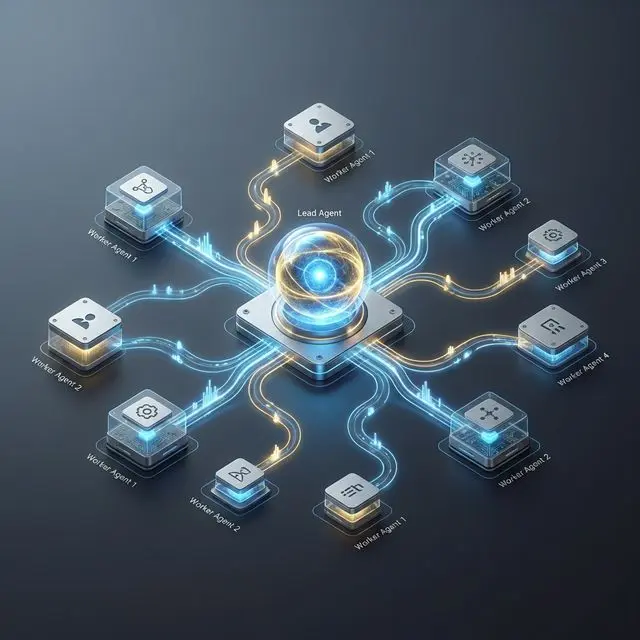
At its heart, Agent Teams implements an Orchestrator-Worker pattern. In a standard Claude Code session, you are the orchestrator. With Agent Teams, you delegate that orchestration to a “Lead Agent.”
graph TD
    User[Developer] --> Lead[Lead Agent / Orchestrator]

    subgraph "Agent Team (Shared Environment)"
        Lead --> T1[Frontend Specialist]
        Lead --> T2[Backend/API Specialist]
        Lead --> T3[QA / Documentation]
    end

    T1 <--> T2
    T2 <--> T3
    T1 <--> T3

    classDef leadNode fill:#4A90D9,stroke:#2E5A8B,color:#fff
    classDef workerNode fill:#70C1B3,stroke:#4A9A8C,color:#fff

    class Lead leadNode
    class T1,T2,T3 workerNode
The Lead Agent doesn’t just “call” teammates; it manages them. It maintains a shared task list, assigns specific scopes of work, and synthesizes the results. Crucially, each teammate operates in its own independent context window, preventing the “context pollution” that often leads to hallucinations in single-agent sessions trying to hold too much code at once.
Under the Hood: Persistence and Communication
Unlike standard subagents that disappear after a single task, Agent Teams are persistent. Anthropic uses tmux under the hood to manage these sessions. This means:
- State Persistence: If a teammate is debugging a complex race condition, it keeps its terminal history and tool state across multiple turns.
- Inter-Agent Messaging: Teammates can talk to each other. A backend agent can message the frontend agent to clarify a JSON structure without having to go back through the Lead or the Developer.
- Scoped Context: Each agent only sees what it needs to see. This focused attention leads to higher quality code and fewer regressions.
Enabling the Power: Experimental Setup
As of now, Agent Teams is an experimental feature. You can’t just click a button; you have to enable the agentic mindset through your environment:
# Enable the experimental feature flag
export CLAUDE_CODE_EXPERIMENTAL_AGENT_TEAMS=1

# Launch Claude Code
claude
Once inside, you have granular control over your team. You can specify different models for different teammates. For instance, you might use Claude 3.5 Haiku for documentation tasks to save on costs, while reserving Claude 3.7 Sonnet for the heavy algorithmic Lead role.
Comparative Analysis: When to Use What?
Small tasks don’t need a team. Over-orchestration can actually slow you down. Here is how Agent Teams stacks up against the alternatives:
| Architecture | Best For | Coordination Complexity | Token Efficiency |
|---|---|---|---|
| Standard Chat | Quick questions, single functions. | Low | High |
| Subagents | One-off helper tasks (e.g., “Summarize this file”). | Medium | Medium |
| Agent Teams | Multi-file refactors, parallel research, TDD. | High | Low (High token usage) |
Advanced Use Cases
Where does the “Team” really shine? Here are three scenarios where a single agent would struggle, but a team thrives:
1. Competing Hypotheses Investigation
When debugging a intermittent production crash, you can spin up three teammates.
- Teammate A: Investigates database connection pools.
- Teammate B: Looks for memory leaks in the cache layer.
- Teammate C: Analyzes network latency spikes. The Lead synthesizes these three reports into a single root cause analysis.
2. Parallel Code Review & Hardening
While you write a new feature, your team “shadows” you. One agent writes unit tests, another scans for security vulnerabilities (SAST), and a third updates the API documentation—all in real-time.
3. Cross-Stack Feature Implementation
Implementing a new “Favorite” button?
- Backend Agent: Updates the PostgreSQL schema and the GraphQL resolver.
- Frontend Agent: Builds the React component and handles the state management.
- Lead Agent: Ensures the bridge between the two remains seamless and the types are consistent.
The Cost of Autonomy
It’s important to talk about the “token tax.” Multi-agent systems can consume anywhere from 4x to 15x more tokens than a standard chat. Every message sent between agents adds to the bill.
Pro-Tip: Always keep “Plan Approval” on. Before your team starts burning through thousands of tokens, review their proposed execution plan. The plan approval hook allows you to steer the team before they head down a rabbit hole.
Conclusion: The Era of the AI Coordinator
We are moving away from the era of “Prompt Engineering” and entering the era of “Agentic Architecture.” The most successful developers in the next five years won’t just be the best coders; they will be the best orchestrators.
Claude Agent Teams is a glimpse into that future—a future where software development is less about manually grinding through line-by-line fixes and more about directing a chorus of specialized intelligences toward a shared goal.
Sources
- [Claude Code Official Documentation] - Orchestrating teams of Claude Code sessions
Share :
Stay Ahead in Tech
Join thousands of developers and tech enthusiasts. Get our top stories delivered safely to your inbox every week.
No spam. Unsubscribe at any time.