Building an AI Software Development Team with Claude Code Agents
- Turker Senturk
- AI
- 17 Jan, 2026
- 11 min read
Building an AI software development team with Claude Code agents
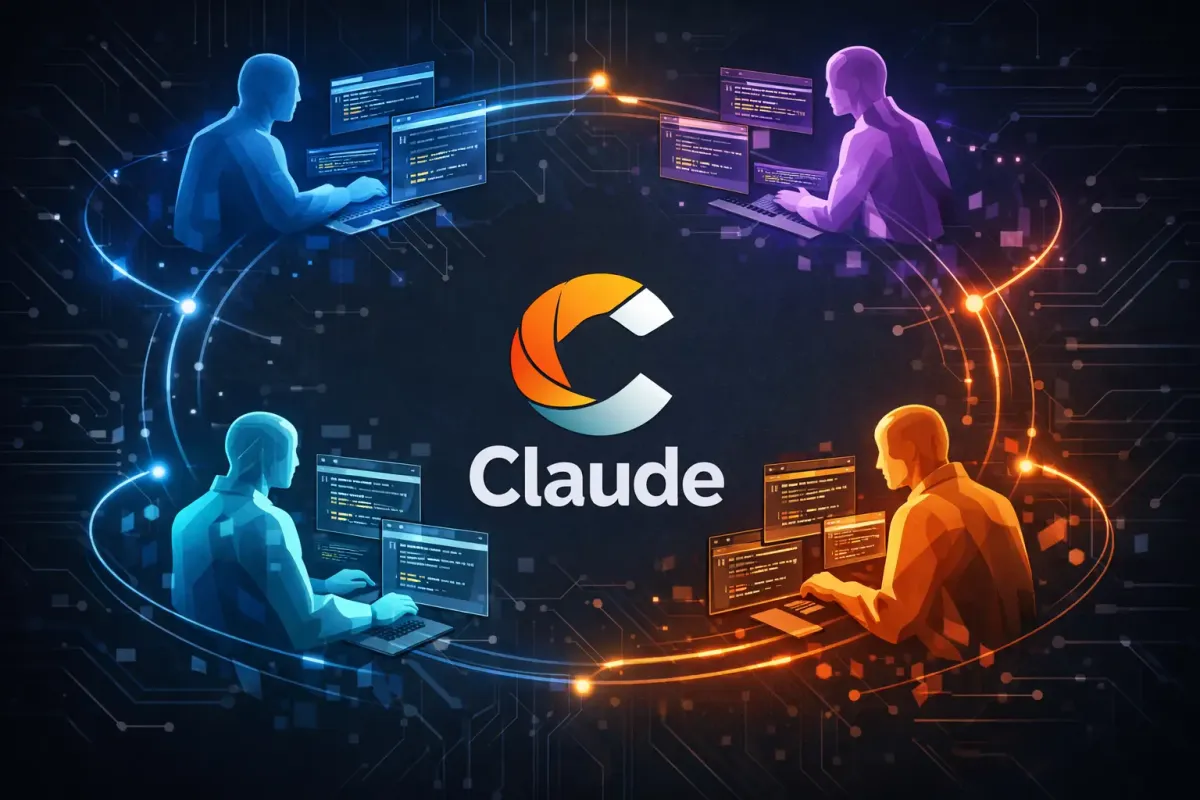
Claude Code’s multi-agent architecture represents a fundamental shift from AI-assisted coding to AI-driven development, where specialized subagents work in parallel like a virtual engineering team. Since its February 2025 launch and September 2025 2.0 release, Claude Code has evolved from a terminal tool into a sophisticated orchestration platform that now generates over $500M in annualized revenue. For developers looking to build artificial software teams, understanding Claude Code’s agent/subagent system—and how it differs from competitors like GitHub Copilot and Cursor—is essential to leveraging this paradigm effectively.
How Claude Code’s agent architecture actually works
Claude Code operates on an orchestrator-worker pattern where a main agent analyzes requests, decomposes them into subtasks, and delegates work to specialized subagents that execute in parallel. The key insight from Anthropic’s engineering team is deceptively simple: “give your agents a computer, allowing them to work like humans do.”
The distinction between agents and subagents is architectural. The main agent is the LLM autonomously using tools in a loop—gathering context, taking action, verifying work, and repeating. Subagents are separate agent instances spawned to handle focused subtasks, each operating in its own isolated context window. This isolation is critical: subagents return only condensed findings to the parent, preventing context pollution and enabling true parallel processing across a 200K+ token context window.
Claude Code includes three built-in subagents that activate automatically. The Explore subagent handles file discovery and codebase search using read-only tools, with configurable thoroughness levels from “quick” to “very thorough.” The Plan subagent performs codebase research during planning phases. The General-Purpose subagent tackles complex multi-step operations requiring full tool access.
Creating custom subagents requires just a markdown file with YAML frontmatter in your .claude/agents/ directory:
---
name: code-reviewer
description: Expert code review specialist for quality and security
tools: Read, Grep, Glob, Bash
model: sonnet
---

You are a senior code reviewer ensuring high standards of code quality.

When invoked:
1. Run git diff to see recent changes
2. Focus on modified files
3. Begin review immediately

Provide feedback organized by priority:
- Critical issues (must fix)
- Warnings (should fix)
- Suggestions (consider improving)
The description field is particularly important—it tells Claude when to automatically invoke this subagent. Tool restrictions enforce the principle of least privilege; a code reviewer needs read access, not write permissions. The model field allows cost optimization by routing simpler tasks to faster models like Haiku while reserving Opus for complex analysis.
Structuring roles for your virtual development team
The most effective AI development teams use task-based specialization over role-based agents. Industry consensus from implementations like VoltAgent’s 100+ agent collection and the MetaGPT framework (63k+ GitHub stars) confirms that narrowly defined agents outperform generalists—though running multiple agents with separate contexts consumes tokens rapidly.
A minimal viable team structure for Claude Code includes four specialized agents: a Planner agent for specifications and task breakdown, an Implementer for code generation, a Reviewer for quality checks, and a Tester for test generation and execution. Larger teams from repositories like wshobson/agents (24.1k stars) extend this to seven or more agents including backend-architect, database-architect, frontend-developer, test-automator, security-auditor, deployment-engineer, and observability-engineer.
Tool permissions should map directly to agent responsibilities. Read-only agents (reviewers, auditors) get access to Read, Grep, and Glob. Research agents add WebFetch and WebSearch. Code writers receive the full set: Read, Write, Edit, Bash, Glob, and Grep. This permission structure prevents accidents—a security auditor shouldn’t be able to modify the code it’s analyzing.
The wshobson/agents repository implements a three-tier model strategy that balances quality and cost. Tier 1 routes critical tasks (architecture, security, code review) to Opus 4.5. Tier 2 uses the inherited model for complex work. Tier 3 assigns Sonnet to supporting tasks like documentation and debugging. Tier 4 reserves Haiku for fast operations like simple deployments.
Communication patterns and workflow orchestration
A fundamental constraint shapes Claude Code’s multi-agent communication: subagents cannot exchange information directly with each other. All communication flows through the orchestrating main agent. This hub-and-spoke topology simplifies coordination but requires explicit handoff design.
The most robust communication method uses file-based handoffs where each subagent saves structured output to distinct files that subsequent agents read as input. This creates an audit trail, reduces context window usage, and makes debugging easier. Agents can return results in predefined JSON or YAML formats that the orchestrator parses for routing decisions.
Four primary orchestration patterns govern multi-agent workflows. The Sequential (Pipeline) pattern creates linear, deterministic flows—Parser → Extractor → Summarizer—ideal for data processing. The Concurrent pattern runs multiple agents on the same task independently, useful for brainstorming and ensemble reasoning. The Hierarchical (Supervisor) pattern places a central coordinator managing all interactions, best for complex multi-domain workflows. The Planner-Worker pattern generates dynamic multi-step plans that workers execute in parallel before a synthesizer combines results.
Claude Code supports parallel execution natively. Pressing Ctrl+B moves a subagent to background execution, and the /tasks command shows all running processes. A prompt like “Explore the codebase using 4 tasks in parallel, with each agent exploring different directories” launches concurrent subagents that surface results through the AgentOutputTool.
Microsoft’s multi-agent guidance emphasizes avoiding highly similar agents, which degrades orchestrator performance. The Maker-Checker loop pattern—where one agent creates and another critiques until quality thresholds are met—provides structured iteration. Clear task boundaries and explicit handoff points prevent duplication and conflicts.
The MCP integration layer
Model Context Protocol (MCP) is Claude Code’s extensibility backbone, described by Anthropic as “USB-C for AI.” Claude Code functions as both an MCP server and client, enabling integration with external data sources, APIs, and services through a standardized interface.
Installing an MCP server takes a single command:
# Remote HTTP server (recommended for cloud services)
claude mcp add --transport http notion https://mcp.notion.com/mcp

# Local stdio server with environment variables
claude mcp add --transport stdio github -- npx -y @anthropic/mcp-github \
  --env GITHUB_TOKEN=$GITHUB_TOKEN
MCP configurations live in .mcp.json at project root, enabling team-shared integrations through version control:
{
  "mcpServers": {
    "github": {
      "type": "stdio",
      "command": "npx",
      "args": ["-y", "@anthropic/mcp-github"],
      "env": { "GITHUB_TOKEN": "${GITHUB_TOKEN}" }
    },
    "postgres": {
      "type": "stdio",
      "command": "npx",
      "args": ["-y", "@anthropic/mcp-postgres"],
      "env": { "DATABASE_URL": "${DATABASE_URL}" }
    }
  }
}
The December 2025 MCP Tool Search feature solved a critical scaling problem. Previously, 7+ MCP servers could consume 67k+ tokens before any prompt was processed. Tool Search implements lazy loading—auto-detecting when tool descriptions exceed 10% of the context window and deferring loading until tools are actually needed. This reduced context consumption from ~134k to ~5k tokens in some configurations.
Popular community MCP servers include GitHub (repo interaction, PRs, CI/CD), PostgreSQL (database queries), Sentry (error tracking), Figma (design extraction), and claude-code-mcp (running Claude Code in one-shot mode from other agents). The Composio Rube server provides universal connectivity with 7 tools supporting any application.
How Claude Code compares to the competition
Claude Code’s approach differs fundamentally from GitHub Copilot, Cursor, and other AI coding tools. The philosophical divide: Copilot’s model is “you drive, AI assists”—Claude Code’s model is “AI drives, you supervise.”
| Capability | Claude Code | GitHub Copilot | Cursor |
|---|---|---|---|
| Autonomous task execution | Full | Limited | Agent mode |
| Multi-file refactoring | Native strength | Iterative chat | Supported |
| Subagents/parallelism | Native | No | Background agents |
| Context window | 200K-1M tokens | 64-128K tokens | 200K-1M |
| Model flexibility | Anthropic only | GitHub models | Multi-model |
On SWE-bench Verified, Claude Opus 4.5 achieved 80.9% compared to Copilot’s default GPT-4.1 at 56.5%. Developer reports indicate Claude Code maintains project awareness for approximately 47 minutes versus Copilot’s 17 minutes—a 2.8x advantage in context retention. One documented case showed a SpringBoot migration projected at 3 months with Copilot completed in 2 weeks with Claude Code.
Cursor optimizes for speed and velocity with a familiar VS Code interface, visual diff review, and multi-model flexibility (GPT, Claude, Gemini). Claude Code optimizes for depth and correctness through its terminal-native approach. Many developers report using both complementarily—Cursor for daily coding and quick edits, Claude Code for complex autonomous tasks and large-scale refactoring.
The multi-agent versus single-agent tradeoff involves context management. Single agents use one context window but suffer exhaustion on complex tasks. Multi-agent systems use more tokens across separate contexts but produce better results with fewer iterations and less rework. Strategic model assignment can offset costs—Haiku for exploration, Sonnet for execution, Opus for critical decisions.
Enterprise cost data from Anthropic shows average usage of ~$6 per developer per day, with 90% of users under $12 daily. Claude Pro at $20/month provides ~45 messages per 5 hours; Max 20x at $200/month provides 900+ messages per 5 hours.
Advanced patterns for production systems
The hooks system enables automated triggers at specific workflow points. PreToolUse hooks can block dangerous operations or validate commands before execution. PostToolUse hooks run formatters after edits, execute tests after changes, or trigger linting before commits.
{
  "hooks": {
    "PreToolUse": [{
      "matcher": "Edit|Write",
      "hooks": [{
        "type": "command",
        "command": "[ \"$(git branch --show-current)\" != \"main\" ] || exit 2",
        "timeout": 5
      }]
    }],
    "PostToolUse": [{
      "matcher": "Edit|Write",
      "hooks": [{
        "type": "command",
        "command": "npx prettier --write \"$file_path\"",
        "timeout": 30
      }]
    }]
  }
}
For CI/CD integration, companies like Elastic have implemented self-healing PRs where AI agents read build failure logs, identify issues, commit fixes to working branches, and trigger pipeline re-runs automatically. The claude-code-action GitHub Action enables mentioning @claude in any PR or issue for autonomous analysis and implementation.
Testing multi-agent output requires abandoning traditional pass/fail approaches. LLM-as-a-Judge evaluation uses automated quality assessment with rubrics. Simulation testing verifies agent behavior across hundreds of personas and scenarios. Trajectory evaluation assesses decision paths rather than just final outputs. Tools like Braintrust provide GitHub Actions for automated evaluation on PRs with score breakdowns.
The CLAUDE.md file hierarchy provides persistent memory across sessions. Files cascade from enterprise → user → project → local levels, with imports via @path/to/file syntax. Extended thinking modes—triggered by keywords from “think” through “think hard” to “ultrathink”—allocate progressively more reasoning budget for complex problems.
Key developments from the 2024-2025 evolution
The September 2025 Claude Code 2.0 release introduced the core multi-agent capabilities: native VS Code extension (beta), checkpoints for automatic code state saving, the Claude Agent SDK for custom agentic experiences, and the subagent/hooks systems. The October 2025 skills and plugin system added organized folders of instructions that Claude loads dynamically, with marketplace support via /plugin install.
December 2025 brought significant architectural improvements: the LSP tool for go-to-definition and find references, asynchronous subagents for true multitasking, MCP Tool Search for context optimization, and sandbox mode for BashTool. The January 2026 2.1.0 release added Shift+Enter for newlines, skills hot reload, wildcard tool permissions, and the /teleport command to move sessions to the web interface.
Community implementations have expanded rapidly. The “Ralph Wiggum” phenomenon—brute force coding via self-healing loops—drove late 2025 adoption. Developers report building complete MVPs in single days using Claude Code with MCP integrations. The workflow shift is significant: developers increasingly act as managers and reviewers rather than writers, with Anthropic claiming 90% of Claude Code itself was written by Claude models.
Conclusion
Building an effective AI software development team with Claude Code requires understanding three core principles. First, architectural isolation through subagents preserves context quality—each specialist gets its own 200K token window, preventing the quality degradation that plagues single-agent approaches on complex tasks. Second, task-based specialization outperforms role-based design—narrowly defined agents with clear tool permissions prove more reliable than generalist configurations. Third, explicit orchestration through the hub-and-spoke model means designing clear handoff protocols between agents, using file-based communication, and structured output formats.
The productivity data reveals important nuances: studies show 20-50% faster task completion for code generation and refactoring, but the METR 2025 study found experienced developers were 19% slower with AI tools in complex legacy codebases. AI excels at greenfield development but requires careful human oversight for production systems. The synthesis challenge—combining work from multiple agents—remains the hardest step, and non-deterministic outputs mean changes ripple unpredictably through workflows.
For teams adopting Claude Code’s multi-agent approach, the path forward is clear: start with a minimal team of 2-3 specialized agents, establish clear tool permissions and handoff protocols, integrate with CI/CD through hooks and GitHub Actions, and treat AI-generated code like any junior developer’s work—valuable but requiring review. The era of AI-driven development is here, and the teams that master multi-agent orchestration will define the next generation of software engineering.
Share :
Stay Ahead in Tech
Join thousands of developers and tech enthusiasts. Get our top stories delivered safely to your inbox every week.
No spam. Unsubscribe at any time.