SoftBank Just Bet $40 Billion on OpenAI—And That's Not Even the Week's Biggest Story
- Türker Şentürk
- AI
- 04 Jan, 2026
- 5 min read
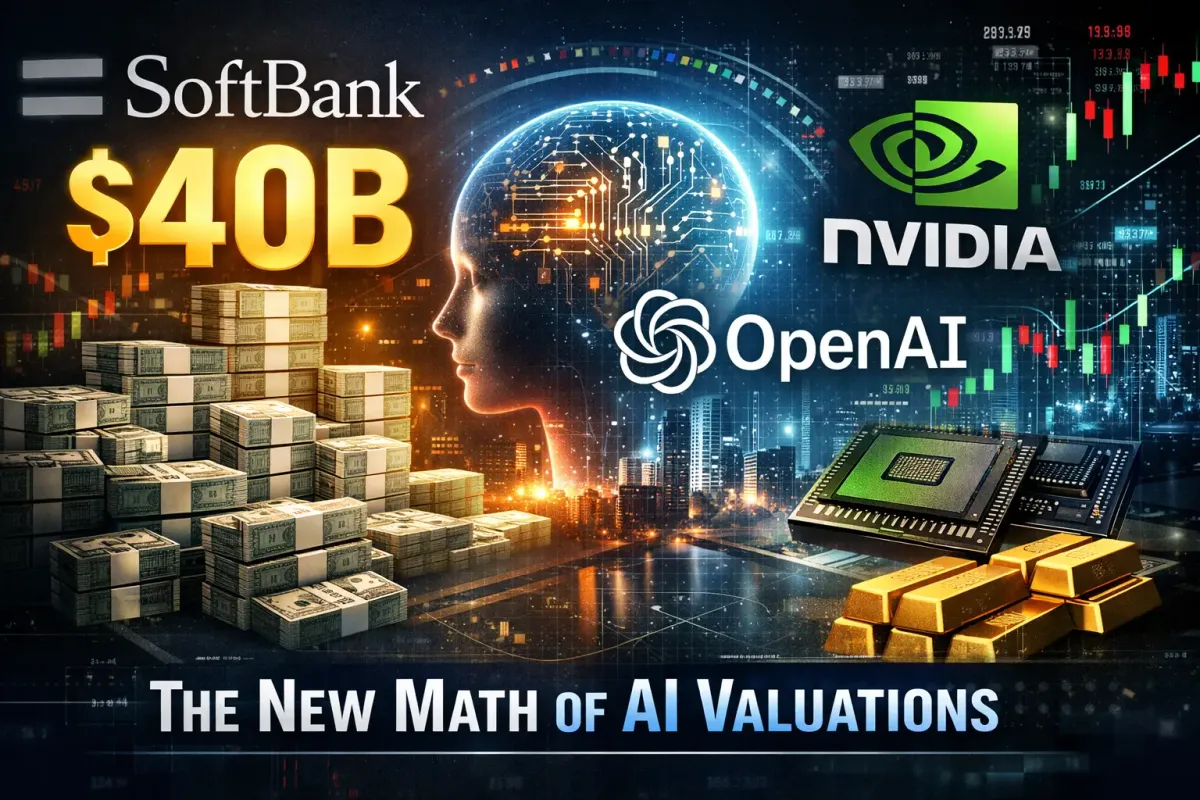
When you casually exit a $5.8 billion Nvidia position to fund your next bet, you’re either catastrophically wrong or playing a different game than everyone else. SoftBank chose the latter this week, dumping those chips into a $40 billion stake in OpenAI.
That’s not a typo. Forty. Billion. Dollars.
For context, that’s roughly what Disney paid for Fox’s entertainment assets, or what Microsoft spent acquiring Activision Blizzard after a year-long regulatory cage match. Except SoftBank just did it for a slice—about 10%—of a company that makes chatbots. Well, chatbots that happen to be reshaping how we work, write, and think about intelligence itself.
The New Math of AI Valuations
Here’s what keeps me up at night: OpenAI’s pre-money valuation now sits at $260 billion. For a company that was essentially a research lab four years ago, that’s the kind of number that makes traditional investors break out in hives. But SoftBank founder Masayoshi Son has never been accused of thinking small. He’s the same person who predicted in 2017 that his Vision Fund would produce “dozens of companies worth more than $100 billion each.”
The bet makes more sense when you consider what SoftBank is actually buying. This isn’t just access to GPT-whatever-comes-next. It’s a front-row seat to what might become the operating system layer of the next computing paradigm. Think of it less like buying shares in a software company and more like securing mining rights before everyone realizes there’s gold in those hills.
Meta Quietly Rewrites the Agent Playbook
While everyone was gawking at SoftBank’s numbers, Meta was making what might be the more telling move: acquiring Manus, a Singapore-based AI agent platform, for roughly $2 billion.
If that sounds like pocket change by comparison, you’re missing the point entirely. Manus isn’t just another AI startup. In a few months of operation, they processed 147 trillion tokens—that’s trillion with a T—and spun up over 80 million virtual computers. These aren’t metrics from a promising prototype. This is production-scale infrastructure doing real work for real users.
The acquisition tells you everything you need to know about where the AI race is actually heading. We’ve moved past the “can we build impressive demos?” phase straight into “can we deploy agents that people trust with their actual work?” Meta just bought a company that answered that second question with a resounding yes.
Here’s the thing about AI agents that nobody tells you upfront: they’re less like apps and more like interns. They need to understand context, handle ambiguity, and recover from mistakes gracefully. Manus figured out how to make that work at scale, which is why CEO Xiao Hong can credibly say they’re “building on a stronger, more sustainable foundation” while keeping operations unchanged. Translation: the tech already works, and Meta knows better than to break what isn’t broken.
The Unsexy Infrastructure Plays
Buried beneath the headline deals are moves that reveal what insiders actually think is valuable. SoftBank didn’t just bet on OpenAI this week—they also dropped roughly $4 billion to acquire DigitalBridge, which owns data centers, fiber, and edge infrastructure. That’s the AI equivalent of buying shovels during a gold rush.
Meanwhile, Octopus Energy spun out Kraken Technologies in a $1 billion round that valued the AI-driven utility platform at $8.65 billion. If you’re wondering what AI operating systems for utilities have to do with the ChatGPT hype cycle, you’re asking the right question. The answer: absolutely nothing, and that’s precisely the point. While everyone obsesses over generative AI, companies like Kraken are quietly using machine learning to solve unsexy problems like grid optimization and energy distribution—the kind of infrastructure work that actually keeps the lights on.
What the Funding Rounds Actually Tell Us
The startup funding announcements this week read like a geography lesson in AI development. Moonshot AI pulled in $500 million from Chinese investors (led by IDG Capital, with Alibaba and Tencent joining) at a $4.3 billion valuation. Their Kimi family of language models might not be household names in the West, but that’s the interesting bit—we’re watching parallel AI ecosystems develop with minimal overlap.
Then there’s the smaller bets that signal where developers think the gaps are. Hypereal AI raised seed funding (amount undisclosed) to build high-performance APIs for AI image and video generation. Block Security Arena hit a $30 million valuation building AI-native security for Web3. Aidoptation scored €20 million for AI-powered autonomous systems in emergency and defense vehicles.
Notice the pattern? Nobody’s funding another ChatGPT competitor. They’re all building picks and shovels—infrastructure, security, specialized applications. The platform war is over. The tooling war just started.
So What Does This Actually Mean?
If you’re a business leader, this week’s deals should crystallize something important: the question is no longer “should we adopt AI?” but rather “which layer of the stack do we need to own?” SoftBank and Meta clearly believe the answer is “as many as possible,” which is why they’re writing checks that make acquisition teams at traditional companies faint.
For developers and technologists, the message is equally clear. The next twelve months won’t be about who can fine-tune the best base model. They’ll be about who can build reliable systems that do boring things exceptionally well—process refunds, route customer service tickets, optimize delivery schedules. Manus proved you can build a business there. Now everyone else is racing to do the same.
And for the rest of us? Well, we’re about to find out whether AI agents are actually ready for prime time, because Meta just bet $2 billion that they are. If Xiao Hong is right about building on a “stronger foundation,” we’ll look back at this week as the moment AI went from impressive to indispensable.
If not, well—SoftBank’s bet on Nvidia seemed weird at first too. Sometimes the craziest-sounding moves are just early.
Tags :
Share :
Stay Ahead in Tech
Join thousands of developers and tech enthusiasts. Get our top stories delivered safely to your inbox every week.
No spam. Unsubscribe at any time.