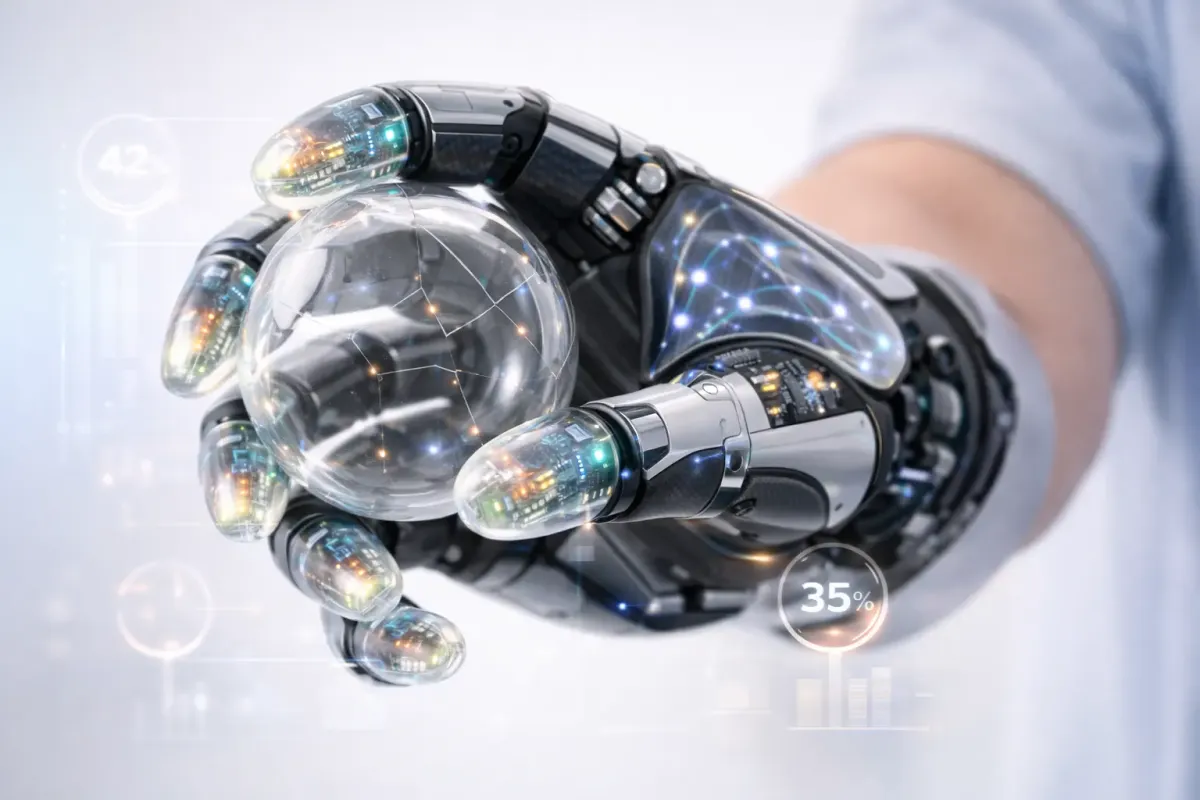
AI Bionic Hand Co‑Pilot Boosts Grip Success to 90%
- Turker Senturk
- AI
- 22 Dec, 2025
- 3 min read
Key Highlights
- The Big Picture: An AI co‑pilot lets bionic hands grip objects with up to 90 % success, narrowing the gap with natural hands.
- Technical Edge: Custom pressure & proximity sensors feed a real‑time AI controller that auto‑adjusts each finger’s force.
- The Bottom Line: Users spend far less mental effort, making prosthetic use feel more like an extension of the body.
Intro: If you’ve ever tried a modern bionic hand, you know the learning curve can feel like juggling 27 joints while keeping your mind on a math problem. The new AI bionic hand co‑pilot changes that by handling the fine‑grained grip adjustments for you, so you can focus on the task at hand.
Why Current Bionic Hands Fall Short
Most commercially available prosthetic hands rely on either preset grip modes or surface electromyography (EMG) signals. Both approaches demand constant, conscious effort from the user. As Jake George explains, a natural hand reflexively tightens its grip within 60–80 ms when an object slips—something current prostheses cannot replicate. The result? Up to 50 % of upper‑limb amputees eventually abandon their devices.
The AI Co‑Pilot: How It Works
The research team started by swapping standard fingertips for silicone‑wrapped pressure and proximity sensors. These sensors detect both the proximity of an object and the exact force needed to hold it without crushing or dropping.
- Data Collection: The hand was moved back and forth over objects thousands of times, creating a training set that taught the AI to recognize shapes and choose the appropriate grip.
- Individual Finger Control: The AI adjusts each finger independently, allowing the hand to “conform” naturally to the object’s surface.
- Shared Autonomy: Unlike earlier prototypes that required users to toggle autonomy, this system stays in the background, letting the user tighten, loosen, or release the grip at will—much like a subtle co‑pilot in a car.
Real‑World Test Results
In lab trials, participants (both intact and amputees) were asked to perform delicate tasks such as drinking from a paper cup or moving an egg.
- Without AI: Success rates hovered around 1–2 out of 10 attempts.
- With AI Co‑Pilot: Success jumped to 80–90 %, and participants reported a noticeable drop in cognitive load.
These numbers show that the AI not only improves performance but also makes the experience feel more intuitive.
The TechLife Perspective: Why This Matters
We’re still a few steps away from a prosthetic that feels indistinguishable from a natural hand, but this AI‑driven shared‑control model is a meaningful stride forward. It proves that incremental sensor‑AI integration can dramatically increase usability without demanding invasive neural implants—yet those remain a promising next frontier. As the technology moves from controlled labs into everyday homes, we may finally see prosthetic hands that assist rather than challenge their users.
Source: Nature Communications, 2025
Tags :
Share :
Stay Ahead in Tech
Join thousands of developers and tech enthusiasts. Get our top stories delivered safely to your inbox every week.
No spam. Unsubscribe at any time.